Robot Cable Sleeves: Why Overlap, Closure and Attachment Control Wear
Examine how a wrap moves through a bend, why damage often starts at its ends, and how to separate abrasion, flame and spatter claims.
Need help selecting? Send photos of the model, nameplate and installation; quantity may be unknown.
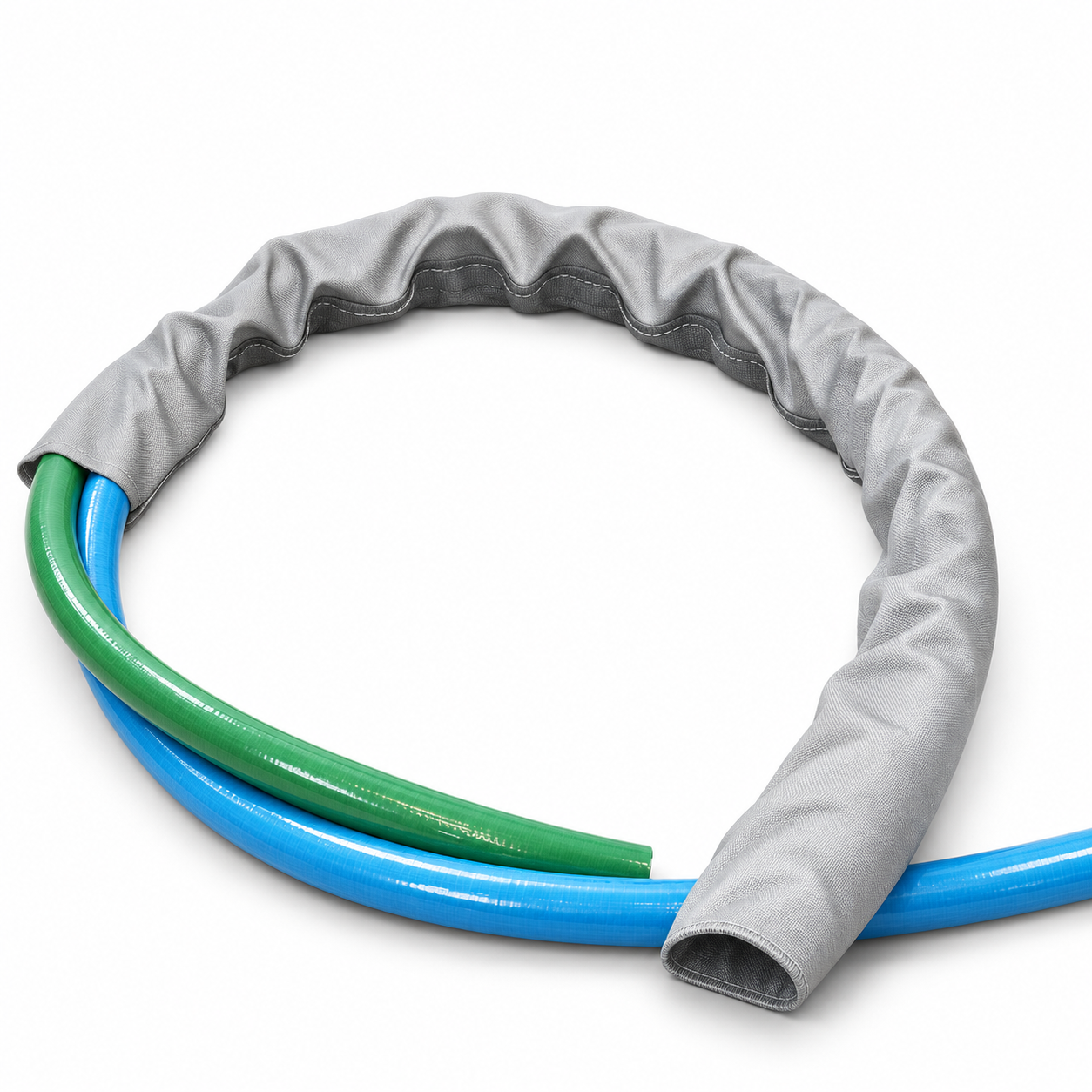
A wraparound sleeve adds an outer wear layer to an existing cable bundle. It can be installed around terminated cables, but its performance depends on the closed shape throughout movement. Flat material width and a nominal bundle diameter do not establish the overlap available at every bend.
Bending redistributes the material
The outside of a curved bundle follows a longer path than the inside. For an ideal circular bend, arc length is radius multiplied by angle in radians. Two paths separated radially by 10 mm differ in length by approximately 15.7 mm over a 90-degree bend. This is a geometric illustration, not a sleeve sizing allowance: actual wraps also slide, wrinkle and change cross-section.
A closure that overlaps adequately on a straight bundle may open where curvature is highest. Conversely, surplus material on the inside can gather into a fold. Check the loaded bundle at both movement extremes and at intermediate positions where it passes a fixture.
| Design feature | Behaviour to observe | Why it matters |
|---|---|---|
| Closure overlap | Whether it remains engaged through the bend | An opening exposes the underlying jacket |
| Seam orientation | Whether it meets the repeated contact surface | Closure edges can become the first wear point |
| End attachment | Whether the sleeve stays located without pinching | Tight retention can concentrate load at the exit |
| Sleeve stiffness | Whether bending becomes localised at the end | Protection can shift damage into the exposed cable |
| Internal cleanliness | Whether particles are trapped under the wrap | Debris can abrade the protected surface |
Inspect beneath the sleeve
External damage is only one part of the evidence. A sound-looking outer wrap can hide grit, a hardened fold or an attachment rubbing the cable. Compare the first exposed section at each end with the middle of the protected section.
If abrasion moves from the centre to the sleeve exit after fitting protection, investigate the transition. Making the wrap longer or tightening it further may move the damage again without correcting the route. The sleeve supplier's attachment method and the cable's dynamic bending requirement should be considered together.
Match the evidence to the claim
| Claim or test | What to ask for | What cannot be inferred from it alone |
|---|---|---|
| Abrasion resistance | Material, contact method and test result | Life in a particular robot cell |
| Flame behaviour | Test method, classification and specimen | Resistance to hot metal spatter |
| Thermal resistance | Temperature, duration and applicable condition | Unlimited exposure to a hot surface |
| Chemical resistance | Specific fluid, concentration and exposure | Suitability for every cleaner or coolant |
| Robot application | Allowed movement and fastening arrangement | Performance after arbitrary installation changes |
The WINLINKS wrap entry is a sourcing reference. Request evidence for the exact offered material and construction; a broad product description does not replace those details. HellermannTyton's protection catalogue is useful for distinguishing protection families, while service-life conclusions require the actual application conditions.
For a controlled comparison, record the same inspection locations, cycle and operating hours before and after an authorised change. Keep rejected samples or clear close-up photographs where practical. That creates evidence of what improved instead of relying only on a cleaner appearance.
Product and technical references
HellermannTyton cable protection catalog Catalog source for the example
Read the field selection guide
Need help selecting? Send photos of the model, nameplate and installation; quantity may be unknown.
Related reading
Choosing XINGYI Cable Sleeving: Expandable PET Braid or Self-Wrapping Construction
Compare six sleeve models by bundle diameter, access method and installed routing needs.
Read article →Selecting a Robot Cable Protection Sleeve: Fit, Closure and Exposure
Choose a sleeve for the existing bundle and the actual wear mechanism. Separate abrasion, spatter and flame requirements, and use the enquiry checklist to define the scope.
Read article →XINGYI Cable Sleeving Installation and Dimensional Inspection Reference
Workshop checks for PET braided and self-wrapping sleeves, including bundle measurement, ends and route clearance.
Read article →