
Selecting a Robot Cable Protection Sleeve: Fit, Closure and Exposure
Choose a sleeve for the existing bundle and the actual wear mechanism. Separate abrasion, spatter and flame requirements, and use the enquiry checklist to define the scope.
Need help selecting? Send photos of the model, nameplate and installation; quantity may be unknown.
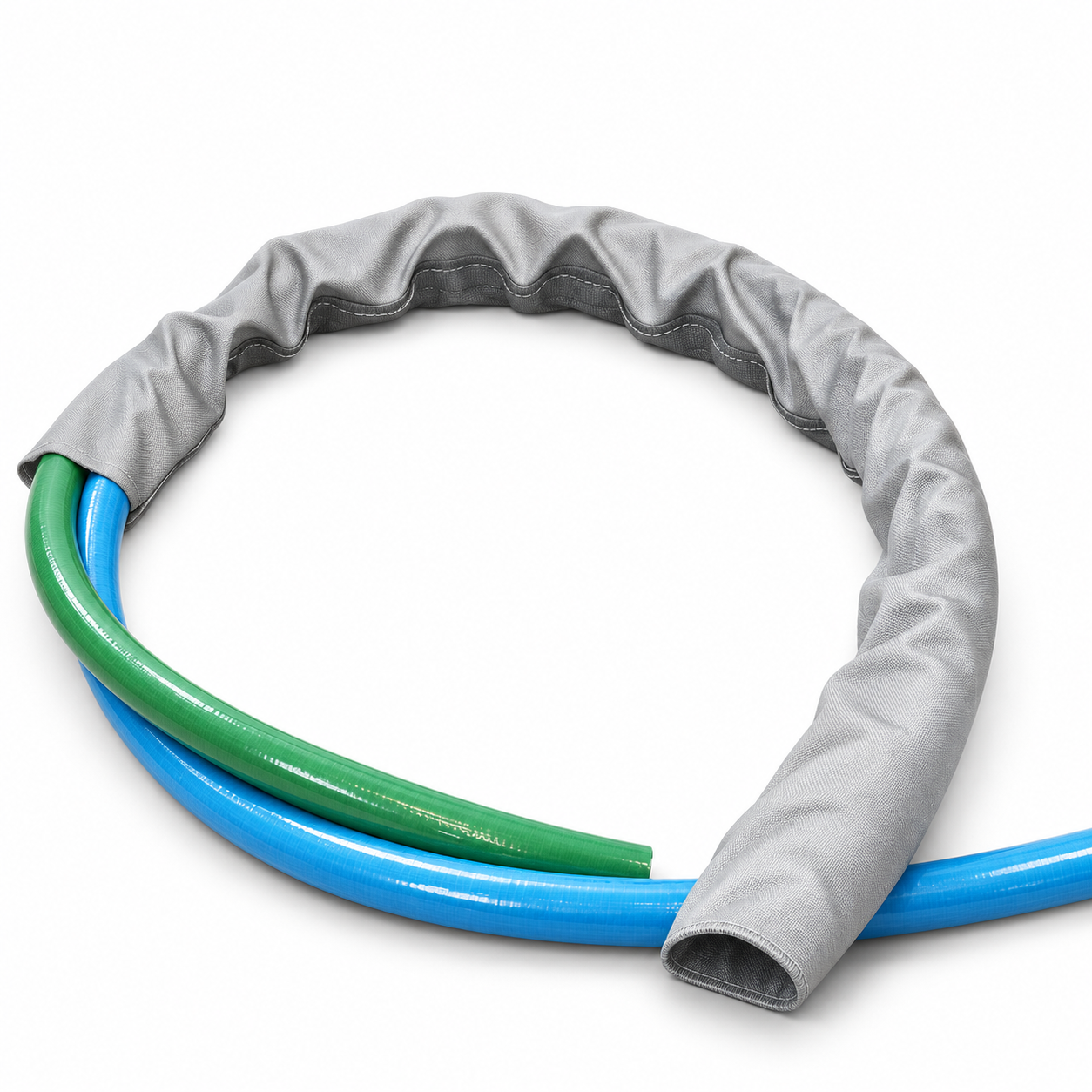
A protection sleeve adds a serviceable outer layer around cables or hoses. It does not repair damaged insulation or correct a route that traps the bundle. Start by identifying the contact location and inspecting the lines underneath, then decide whether a sleeve is the appropriate protection for a sound assembly.
Work out how the sleeve will be installed
If the connectors will remain attached, ask whether the proposed sleeve opens along its length or must slide over an end. “Flexible” does not mean “wraparound.” The WINLINKS listing provides a candidate to discuss, but the quotation should identify the closure construction and the supplied length explicitly.
Measure the largest section within the protected area, including sleeves, joints or fittings already present. Describe a round bundle by its measured circumference or relevant diameters; show an irregular bundle in a cross-section photograph. Do not choose a nominal sleeve diameter using just one cable in the group.
| Check | What to provide | Common mismatch |
|---|---|---|
| Assembly access | Connector sizes and whether ends can be disconnected | A closed sleeve cannot pass the fitted connector |
| Bundle envelope | Largest section, shape and local fittings | Sleeve fits the straight run but not a transition |
| Closure | Proposed overlap, access and surrounding obstructions | Closure opens or catches during bending |
| Protected length | Wear area plus agreed end positions | An edge lands at the same repeated rubbing point |
| Movement | Tightest bend, twist and reversal | Sleeve bunches or restricts the existing route |
Specify the threat instead of requesting “heavy duty”
Abrasion, hot spatter, continuous heat and a flame-test requirement are separate properties. A fabric that performs well against one exposure is not automatically qualified for the others. Supply the actual process and ask for the applicable material data and test conditions, rather than treating a descriptive product name as certification.
For a rubbing problem, document the surface being contacted and the direction of movement. For welding exposure, explain where spatter reaches the bundle and how the sleeve will be inspected or replaced. For cleaning, provide the chemical and operating conditions. Avoid inferring heat resistance or electrical protection from colour or thickness.
Quote the service arrangement as well as the material
| Enquiry input | Supplier response needed |
|---|---|
| Bundle measurements and photographs | Size, usable coverage and closure allowance |
| Exposure and site requirements | Material construction and supporting evidence |
| Installation access | Wraparound or end-fed installation method |
| Inspection and replacement access | End retention and service procedure |
| Quantity and delivery requirement | Cut length, supplied accessories and lead time |
Ask what retains the ends and whether that retention permits the intended movement. Do not assume extra cable ties are acceptable at every location: the equipment team should define where restraint belongs and where the bundle needs to move.
Review the first installation before stocking spares
Under the approved machine procedure, check the sleeve at the most constrained poses and on the return path. Look for migration, closure separation, bunching and new contact points. Set an inspection interval based on the application and initial findings, not an invented universal cycle life.
Save the accepted sleeve code, cut length and end positions. A sacrificial layer is useful only when its condition can be seen and it can be renewed before the underlying cable is affected. Send these details through Discuss your requirements for a repeatable quotation.
Product and technical references
HellermannTyton cable protection catalog Catalog source for the example
Need help selecting? Send photos of the model, nameplate and installation; quantity may be unknown.
Related reading
Choosing XINGYI Cable Sleeving: Expandable PET Braid or Self-Wrapping Construction
Compare six sleeve models by bundle diameter, access method and installed routing needs.
Read article →XINGYI Cable Sleeving Installation and Dimensional Inspection Reference
Workshop checks for PET braided and self-wrapping sleeves, including bundle measurement, ends and route clearance.
Read article →Robot Cable Sleeves: Why Overlap, Closure and Attachment Control Wear
Examine how a wrap moves through a bend, why damage often starts at its ends, and how to separate abrasion, flame and spatter claims.
Read article →