
Robot Protective Covers: Leakage Paths, Moving Cuffs and Material Claims
Understand why fabric performance does not establish whole-cover protection, and how seams, closures and wrist motion change the exposure.
Need help selecting? Send photos of the model, nameplate and installation; quantity may be unknown.
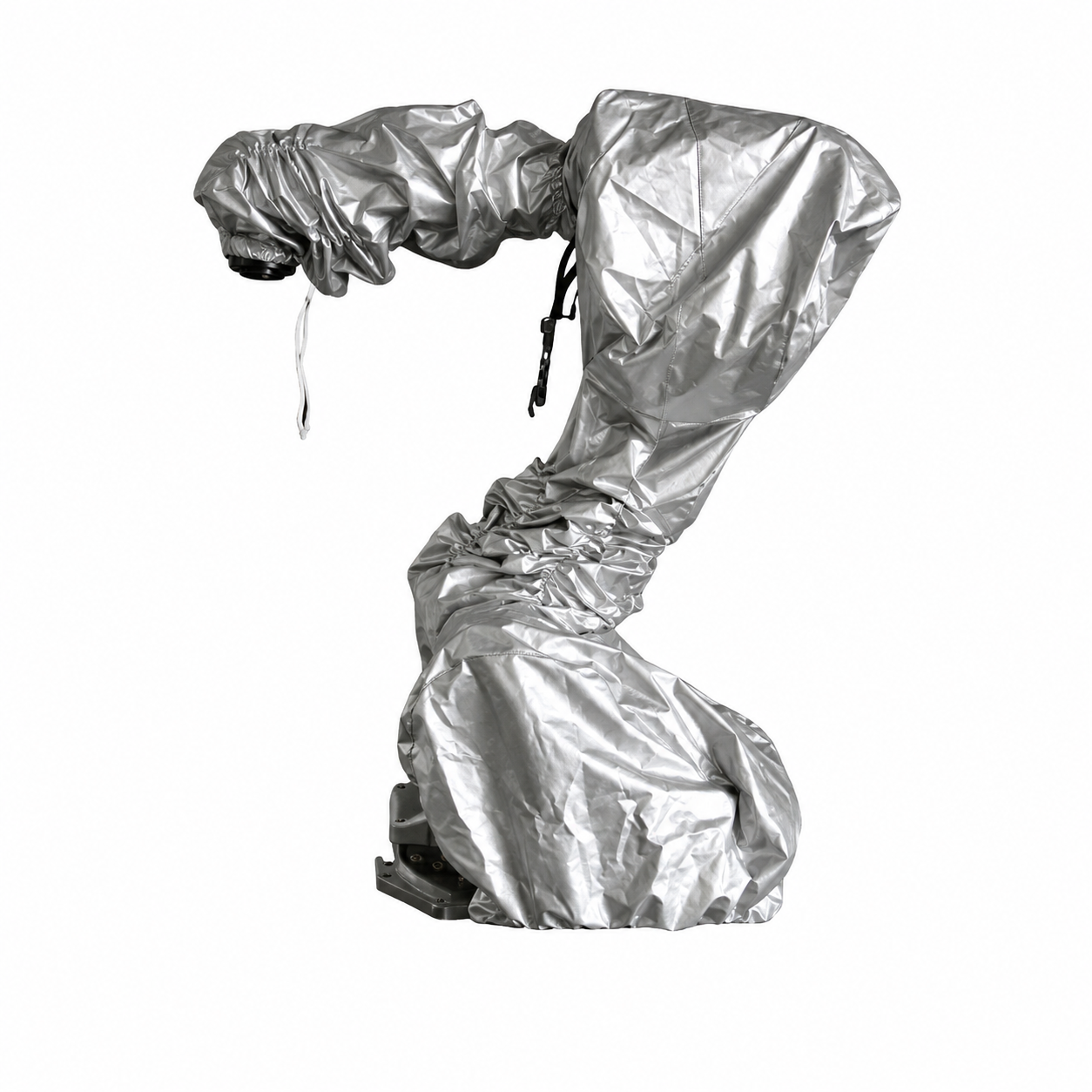
A robot cover is an assembly of fabric, seams, closures and openings that changes shape with the arm. A material swatch can resist a fluid while the completed cover admits it elsewhere. Diagnose the path into the cover before assigning the problem to the fabric.
Locate the first entry point
The first visible wet area is not always the point where liquid entered. Fluid can run along a fold, wick through a seam or collect in a pocket before appearing at a lower opening. Record the parked orientation, cleaning direction and the pattern on both sides of the cover where inspection is permitted.
Distinguish penetration through material from entry through a gap. The appropriate remedy can differ: changing a material does not close an exposed cuff, while tightening a cuff does not establish chemical compatibility.
| Potential path | Mechanism to investigate | Useful inspection evidence |
|---|---|---|
| Stitch line | Local opening or seam construction | Seam location relative to fluid direction |
| Closure overlap | Liquid reaches an exposed edge | Closure direction and coverage in working poses |
| Wrist or tool opening | Gap appears as fabric moves | Same cuff at opposite wrist positions |
| Fabric surface | Penetration or chemical degradation | Exact medium, exposure and material condition |
| Fold or pocket | Liquid accumulates before entering elsewhere | Parked shape and drainage path |
Motion changes the seal geometry
A cuff may appear well fitted at the home position and lift when wrist rotation pulls the sleeve tight. Additional loose material can restore reach but gather into a pocket or rub a fixture. Review shoulder, elbow and wrist behaviour together rather than adjusting one opening in isolation.
The actual tool interface and dress pack occupy space under or beside the garment. A cover made for the robot body alone may therefore behave differently with the production tooling. Preserve those configuration details when comparing a replacement.
ASP's cleaning-process cover guidance illustrates the need for application-specific protection. The listed Leisen cleaning cover and spray-painting cover are distinct configurations; a successful cleaning application does not establish antistatic or painting suitability.
Separate the claims in a supplier report
| Claim | Evidence to identify | Question left open |
|---|---|---|
| Chemical resistance | Medium, concentration, temperature and duration | Does it cover the actual cleaning cycle? |
| Resistance to penetration | Method and tested assembly or specimen | Were seams and closures included? |
| Electrostatic behaviour | Material, construction and stated test | Does the installed arrangement meet the application's requirements? |
| Freedom of movement | Robot, tool and tested poses | Are the production motions included? |
| Service durability | Exposure and inspection conditions | Are wear and cleaning changes accounted for? |
Do not combine separate reports into an unsupported whole-cover approval. A garment alone does not change the robot's approved operating environment or area classification.
After a justified change, compare the same exposure and movement conditions and document where moisture or wear is found. Include the material revision and closure arrangement with photographs. This supports a meaningful repeat order and gives the supplier a specific failure mechanism to address rather than a general request for a stronger cover.
Product and technical references
- Custom cover for Kawasaki BX300L in cleaning applications
- Spray-Painting Robot Cover (Antistatic Option)
ASP robot covers for cleaning processes Catalog source for the example
Read the field selection guide
Need help selecting? Send photos of the model, nameplate and installation; quantity may be unknown.
Related reading
How to Specify a Robot Protective Cover for Washing or Painting
Match the cover to the full robot variant, process exposure and working movement. Use the application comparison and quotation checklist to define fabric, seams, closures and service access.
Read article →