
Robot Conduit Bumpers: Contact Geometry, Wear and Clearance
Understand what a protector can change at a wear point, why rib count cannot predict service life, and how to inspect the conduit beneath it.
Need help selecting? Send photos of the model, nameplate and installation; quantity may be unknown.
A conduit bumper creates an outer contact surface around a robot's corrugated tube. Its value depends on where contact occurs and what that contact does. Sliding abrasion, repeated impact and a sharp fixture edge are different loading conditions; a product described as a bumper does not automatically solve all three.
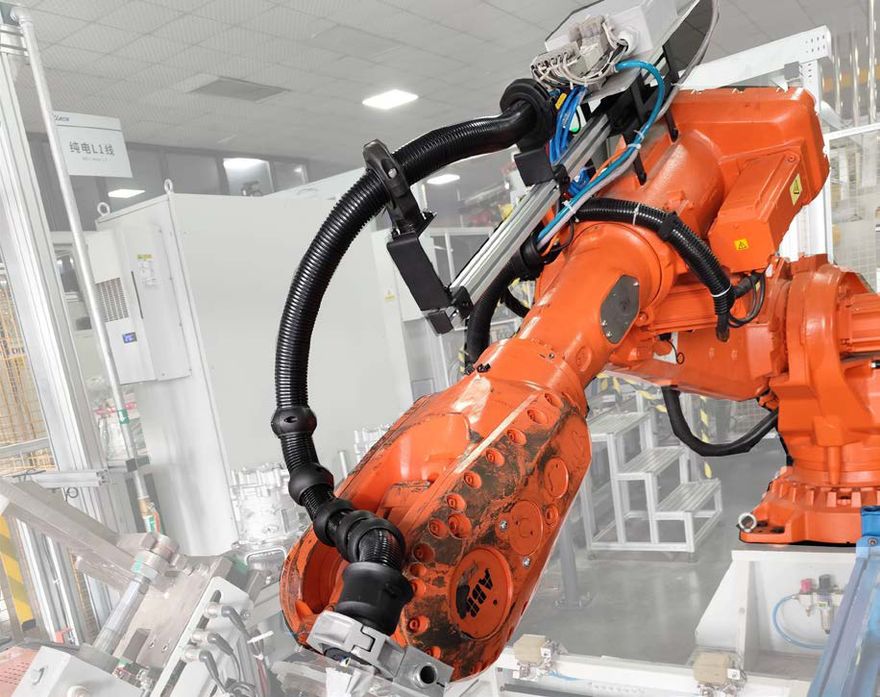
Follow the contact through the robot movement
Begin with an overall route view and the exact robot pose associated with the mark. The installed photo provides system context; it does not establish that either TYSEM spare-part code below is fitted to that robot.
At a contact point, the protector can separate the tube from the neighbouring surface and take some wear itself. It also increases the local envelope. That extra material can reduce clearance to a clamp, fixture or tool, moving the problem elsewhere if the route is not reviewed.
| Contact condition | What the protector may change | What still needs investigation |
|---|---|---|
| Repeated sliding | Provides a replaceable outer contact surface | Contact pressure, sliding distance and material pairing |
| Contact with an edge | Separates the tube from direct contact | Whether the edge cuts the protector or traps it |
| Repeated impact | Changes the local contact geometry | Actual load, deformation and permitted application |
| Tube rubbing inside the fitting | May conceal the affected area | Fit, retention and wear beneath the protector |
| Insufficient motion clearance | Adds bulk to an already crowded route | Repositioning, route redesign or another arrangement |
Rib count is a description, not a life prediction
TYSEM lists 0317Q2-048 as double-rib in the Ø48 family and 0317Q1-070 as single-rib in the Ø70 family. Those are different size families as well as different descriptions. Comparing their names does not isolate the effect of rib geometry.
The original catalogue uses a shared family illustration for the two records. It cannot supply an exact geometric comparison. Obtain the drawings for the specific parts, including overall envelope, tube interface and retention method. Material and application data are needed before discussing a wear advantage.
HELU's dress-pack component guidance places protectors alongside conduit, holders and other routing parts. This supports treating protection as part of the route. It does not provide a collision-energy rating for the TYSEM parts.
Use wear marks to choose the next check
| Observation | Hypothesis to investigate | Evidence that helps distinguish it |
|---|---|---|
| Broad polished patch | Repeated sliding | Matching surface and movement at the affected pose |
| Narrow cut or groove | Edge contact or trapped debris | Opposing geometry and particles at the contact |
| Protector has migrated | Retention or fit issue | Original position, approved tube size and fastening method |
| Outer surface looks sound but tube is damaged | Concealed internal contact | Inspection under the fitting |
| New interference after replacement | Different envelope or location | Exact dimensions and critical-pose clearances |
Record both outer and underlying wear before changing parts. After correcting an identified cause, compare the same locations over a defined service interval. Keep operating conditions with the observations; a different robot cycle or fixture can invalidate a simple before/after comparison.
These accessories protect conduit. Claims about absorbing specified robot impacts require separate load and energy evidence. Use the site's safe maintenance and commissioning procedures when inspecting a moving route.
Products and references
TYSEM catalogue: Section A, items 1 and 14. HELU guide to conduit protectors and other dress-pack components.
What is a robot conduit bumper ball? Installation context and buying checklist
Need help selecting? Send photos of the model, nameplate and installation; quantity may be unknown.
Related reading
What Is a Robot Conduit Bumper Ball? Types, Uses & Selection Guide
See where a bumper ball fits on a robot dress pack, what it protects, and how to check TYSEM part codes, conduit series and movement clearance before ordering.
Read article →