
What Is a Robot Conduit Bumper Ball? Types, Uses & Selection Guide
See where a bumper ball fits on a robot dress pack, what it protects, and how to check TYSEM part codes, conduit series and movement clearance before ordering.
Need help selecting? Send photos of the model, nameplate and installation; quantity may be unknown.
A robot conduit bumper ball is a protective fitting around the outside of the corrugated tube that carries a robot's cables and hoses. Its outer body provides a contact surface that helps protect the tube from rubbing against nearby surfaces. It is a dress-pack accessory, not a robot joint or a collision sensor.
Where is it installed?
Follow the black corrugated tube in the installation photo below. It loops outside the orange robot arm towards the wrist. The rounded protective fittings sit around the tube near the wrist; the larger guide assembly higher on the arm helps manage the route. These parts work together, but have different jobs.
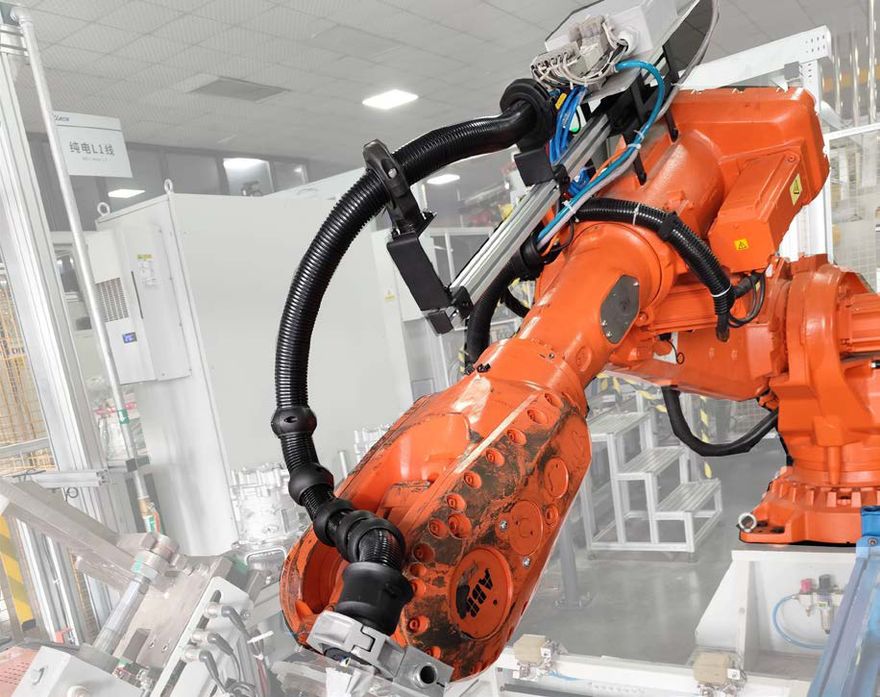
A bumper may be placed where the conduit needs a protective contact surface, subject to the dress-pack design. Its position must be checked through the robot's movement, not just in the parked pose. The photo shows the installation context; it does not identify either order code below or establish compatibility with your robot.
Understand the system before buying the spare
A dress pack is the assembly that routes cables and hoses along the robot. The bumper is one part of that assembly. If the actual problem is excess slack, a damaged tube or a loose anchor, replacing a bumper alone may leave the cause unresolved.
| Component | What it does | What to check when replacing it |
|---|---|---|
| Corrugated conduit | Encloses and protects the cable and hose bundle | Tube series, profile, material and the approved routing requirements. |
| Bumper / conduit protector | Adds a protective contact surface around the conduit | Exact part code, fit on the tube, retention and clearance around its outer body. |
| Holder, clamp or mounting base | Locates and supports the conduit along the robot | Mounting interface and whether the location is fixed, guided or allowed to move. |
| Return spring or retraction unit | Manages the changing length of the moving loop | Required travel, force, bundle weight and the system's mounting arrangement. |
HELU's dress-pack component guide describes these separate roles, including conduit protection and spring-return systems. Use the drawing and instructions for the actual supplier's assembly when selecting replacements.
Single-rib and double-rib: read the complete TYSEM order code
The two published TYSEM examples differ in both their catalogue designation and conduit series. They are not direct substitutes, and the pair does not demonstrate that one rib arrangement lasts longer than another.
| TYSEM order code | Catalogue designation | Applicable conduit series | Buying implication |
|---|---|---|---|
| 0317Q2-048 | Double-rib bumper ball | Ø48 family | Confirm this complete order code against the existing part or assembly BOM. |
| 0317Q1-070 | Single-rib bumper ball | Ø70 family | Confirm the Ø70 assembly interface; do not substitute based on a similar photo. |
The catalogue uses the same family illustration for both entries. Do not count visible rings in that picture to identify the variant. Ask for the exact part drawing to confirm the rib profile, mating features and installed dimensions. TYSEM Products Catalogue, Section A, items 1 and 14
The Ø48 and Ø70 labels identify the applicable conduit family; they are not the bumper's outside diameter. TYSEM's published conduit data distinguishes an inner/outer diameter of 48/54.5 mm for the φ48 family and 70/80 mm for the φ70 family. Those are tube dimensions, not bumper dimensions or universal dimensions for every supplier's conduit. TYSEM conduit interface data
Check the route before adding protection
A larger protective fitting also occupies more space. First check whether the conduit route or mounting arrangement should be corrected to remove unwanted contact. Then assess the proposed fitting's clearance at wrist extremes, close to clamps, around the tool and near fixtures.
For an existing wear problem, record the contact location and the robot pose in which it occurs. Inspect the conduit beneath the old protector as well. Repeated damage, a moving protector or a sharp cut calls for a review of the cause, not an assumption that a larger bumper will fix it. Any motion check should follow the site's safe commissioning procedure.
Procurement checklist: what to send with the enquiry
| Information | Buyer supplies | Supplier confirms |
|---|---|---|
| Existing component | Legible part code, assembly BOM or photos of the removed part | Exact replacement code and whether it is the same variant. |
| Tube interface | Supplier, conduit series, profile and measured outside diameter | Approved mating features, retention and installation method. |
| Robot and route | Robot model, wrist/tool arrangement and overall routing photo | Application fit; a robot brand name alone does not establish compatibility. |
| Wear or interference | Close-up of the contact point and the relevant robot poses | Whether a bumper replacement is appropriate or the route needs correction. |
| Available space | Clearance to fixtures, clamps and the tool through the required movement | Installed outer dimensions and any remaining checks before release. |
| Supply | Quantity, required date and existing spare-part references | Exact item, included hardware, drawing revision and delivery terms. |
Common questions
Is a double-rib bumper always better?
Rib count alone is not a wear-life rating. Fit, material, contact geometry, retention and movement all matter. These two TYSEM entries belong to different tube families, so they are not a controlled performance comparison.
Does the bumper protect the robot from a collision?
Its role here is conduit protection. Do not treat it as a rated robot collision absorber, a safety device or a substitute for correcting mechanical interference. A claim about absorbing a specified impact would require separate manufacturer data.
Do I need a bumper or a complete dress pack?
Start with the failed part and the cause. For a confirmed local spare replacement, use the exact part code and interface drawing. For repeated rubbing, excess slack or a changed tool, review the complete routing system.
Explore the related ranges: robot dress packs, conduits, mounting bases and return springs.
Need help selecting? Send photos of the model, nameplate and installation; quantity may be unknown.
Related reading
Robot Conduit Bumpers: Contact Geometry, Wear and Clearance
Understand what a protector can change at a wear point, why rib count cannot predict service life, and how to inspect the conduit beneath it.
Read article →