
Robot Return Springs: How Preload, Spring Rate and Working Travel Interact
Understand the load at each installed length, why solid height is not a normal working limit, and what to investigate when a dress pack stops returning smoothly.
Need help selecting? Send photos of the model, nameplate and installation; quantity may be unknown.
A return spring is defined by its force over the mechanism's working travel, not just its free length and outside diameter. The installed compression establishes the initial force; further compression increases it. A replacement can fit the space and still change the load applied to the conduit, guides and tool connection.
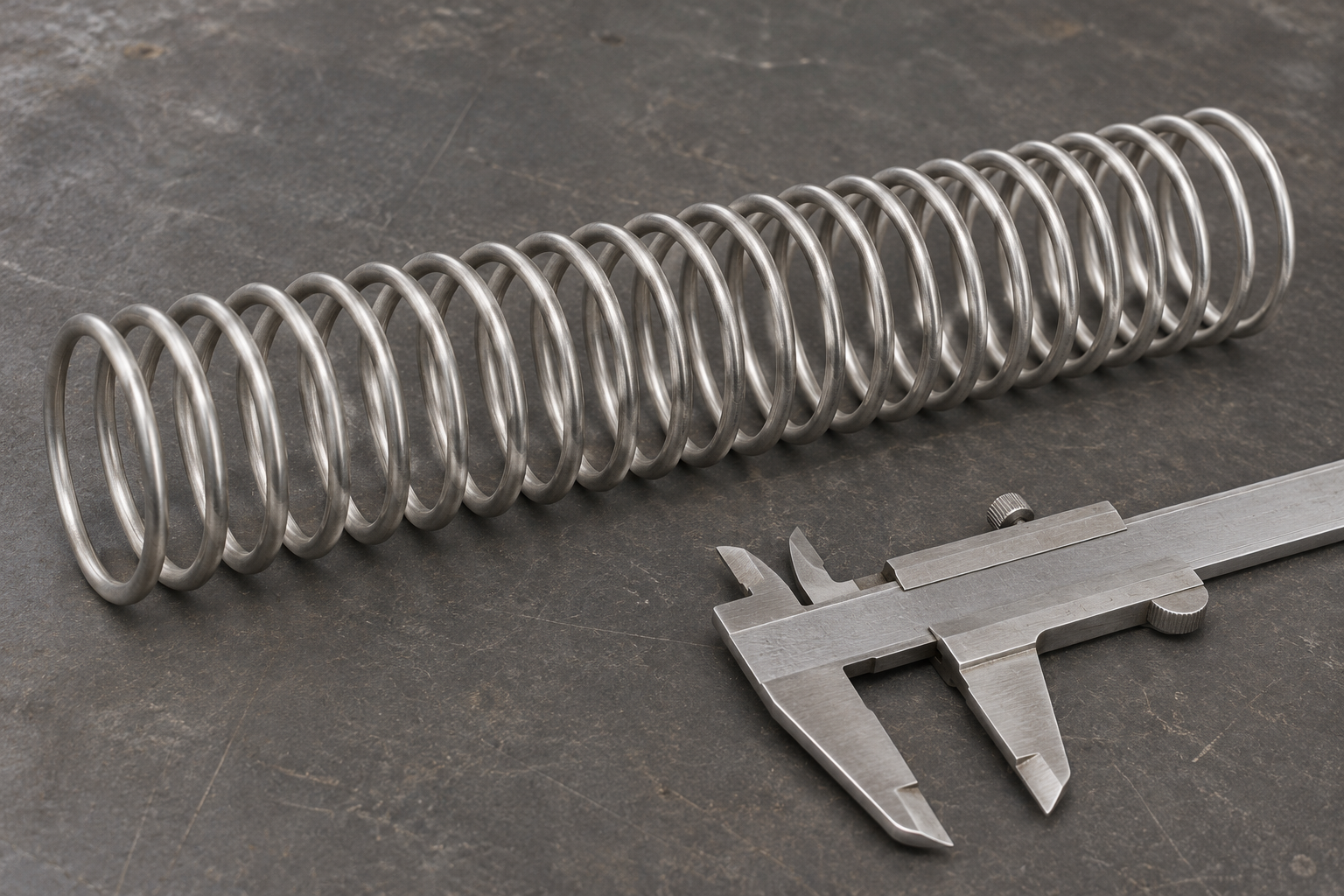
Calculate the force change before interpreting the symptom
Within an approximately linear working range, F = k × x, where k is the spring rate and x is compression from free length. The mechanism may apply a different output force if it includes levers or other transmission geometry. Friction also separates the loading and unloading behaviour of the complete retractor.
Consider an illustrative spring with a rate of 2 N/mm, installed with 15 mm compression. Its initial force is approximately 30 N. Another 10 mm of spring compression raises the force to approximately 50 N. These are assumed values to explain the relationship, not specifications for TYSEM 0333TH-048.
| Assumed state | Compression from free length | Approximate spring force |
|---|---|---|
| Unloaded spring | 0 mm | 0 N |
| Installed starting position | 15 mm | 30 N |
| End of an additional 10 mm compression | 25 mm | 50 N |
| Same end position with a different 3 N/mm spring | 25 mm | 75 N |
The last row shows why matching dimensions is insufficient. A higher-rate substitute changes the load throughout the cycle. Altering installed length changes preload too, even when the spring itself is unchanged.
Keep three limits separate
Free length is measured without an applied load. Working lengths describe the positions actually reached in service. Solid height is the compressed length at which coils close together; it is not an automatic permission to cycle repeatedly to that position.
Allowable stress and fatigue requirements can impose a minimum working length above solid height. Manufacturing tolerances, guide clearances and the mechanism's stops also need review. Obtain the exact load–length data and cyclic operating limits instead of assigning a universal percentage of available compression. Lee Spring distinguishes these quantities in its engineering guidance; the actual replacement still needs its own specification.
Diagnose the complete return path
| Observation | Possible mechanism | Evidence to collect |
|---|---|---|
| Bundle remains extended | Insufficient return force, guide friction or snagging | Installed length, guide condition and location of the hesitation |
| Force rises abruptly near travel end | Coil closure, mechanical stop or blocked guide | Minimum spring length and remaining mechanism travel |
| Coil rub marks appear on one side | Misalignment or inadequate guidance | Seat alignment and guide clearances |
| Return deteriorates after repeated cycles | Changed spring length, friction or damaged components | Before/after dimensions and service history |
| Connectors are pulled despite a tidy outer route | Excess load or incorrect strain relief | Load path through the internal cables and supports |
These observations identify checks rather than proving a cause. Compare the complete assembly with the accepted baseline before changing preload. Stored spring energy requires the equipment's unloading and maintenance procedure; measuring a loose sample does not reveal its installed force.
Retain the exact spring code, supplier drawing, approved working lengths and stop settings. Those records make a replacement reproducible and allow later wear to be related to operating conditions instead of appearance alone.
Product and technical references
Lee Spring engineering catalog Catalog source for the example
Read the field selection guide
Need help selecting? Send photos of the model, nameplate and installation; quantity may be unknown.
Related reading
How to Select a Robot Dress-Pack Return Spring: Fit, Force and Travel
Identify the return mechanism, compare working lengths and load requirements, and prepare a complete replacement enquiry. Includes a TYSEM 0333TH-048 example and a buyer's checklist.
Read article →