
How to Select a Robot Dress-Pack Return Spring: Fit, Force and Travel
Identify the return mechanism, compare working lengths and load requirements, and prepare a complete replacement enquiry. Includes a TYSEM 0333TH-048 example and a buyer's checklist.
Need help selecting? Send photos of the model, nameplate and installation; quantity may be unknown.
A replacement dress-pack spring must fit its seats, provide the required return force and accommodate the mechanism's full working travel. A matching diameter or a familiar catalogue photograph is only a starting point. Before ordering, collect the assembly identity, the spring specification and the positions at which the spring works.
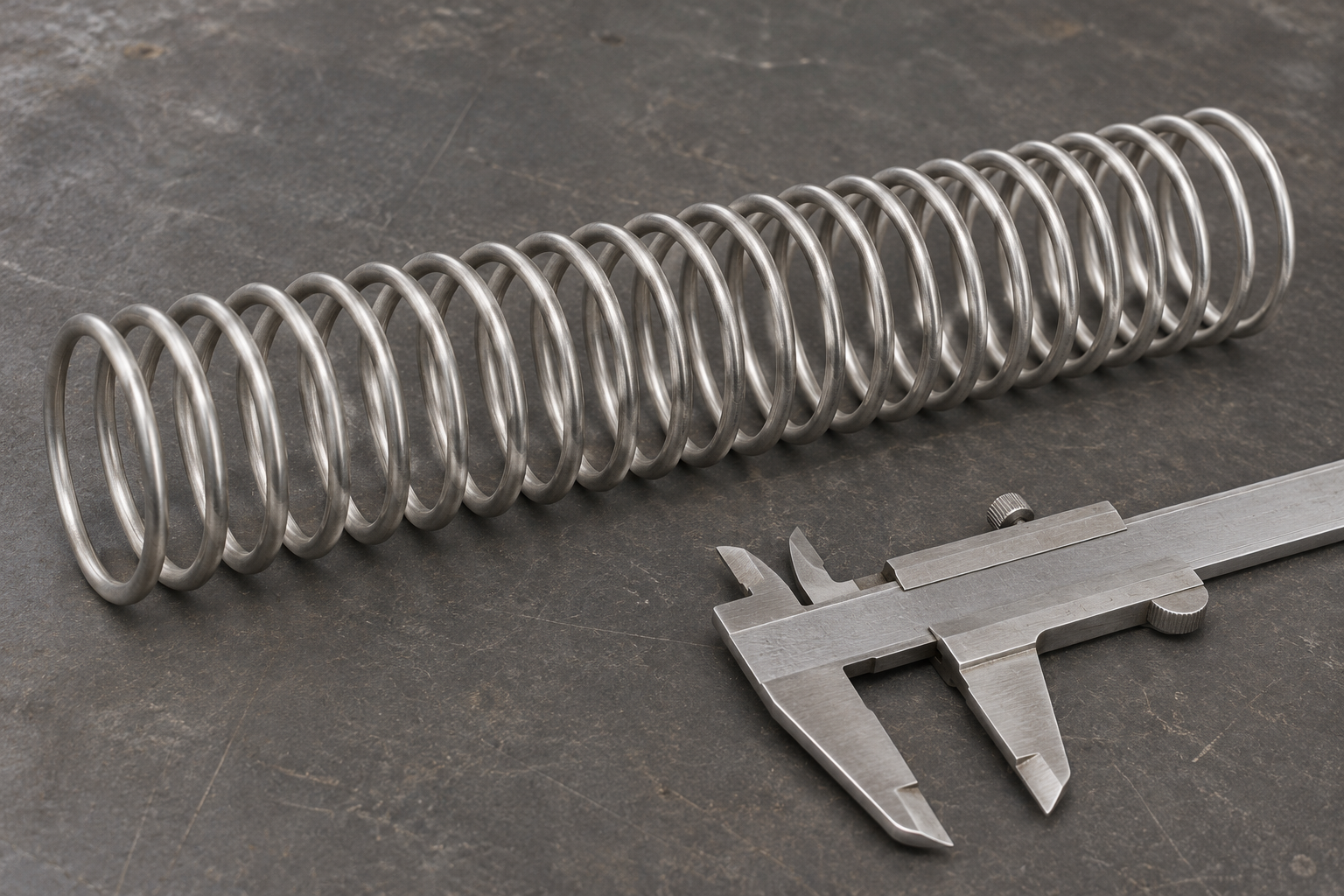
What the spring does in a robot dress pack
A dress pack carries cables and hoses along the robot. In a spring-based return assembly, the spring helps manage the length released as the arm moves and recovered as it returns. The spring works together with guides, stops, seats and the moving bundle. Its replacement therefore belongs to a particular mechanism, rather than simply to a robot brand.
Compression springs resist shortening; their force depends on deflection within the specified operating range. Free length, spring rate and solid height describe different properties. Solid height is the tightly compressed condition, not a recommended operating position. See Lee Spring's compression-spring definitions.
A weak return does not identify the failed part
Consider this troubleshooting situation: the bundle no longer retracts after a tooling change. A stronger spring may appear to solve it, but the changed cable load, routing or guide friction still needs investigation. Ask maintenance to identify where movement becomes restricted and whether the problem began after a cable, hose, clamp or program change.
Photograph the return assembly and its identification plate before requesting a spring. Measurements involving disassembly or stored spring energy belong to qualified maintenance personnel following the equipment service procedure. A purchaser can collect drawings and records without dismantling the mechanism.
Separate the dimensions from the force requirement
Use the approved drawing or an undamaged reference part. A worn or permanently shortened spring is evidence of its present condition, not necessarily its original specification. Lee Spring's measurement guidance distinguishes wire diameter, coil outside diameter, unloaded length, coil count and end form.
| Check | Information to obtain | Purchase mistake to avoid |
|---|---|---|
| Assembly identity | Mechanism maker, assembly code, revision and spring order code | Ordering by the robot model alone |
| Radial fit | Spring outside/inside diameter, guide diameter and housing clearance | Treating the conduit series as the spring diameter |
| Free length and end form | Unloaded length; photographs or drawing of both ends and seats | Matching length while overlooking the seating interface |
| Working lengths | Installed reference length and shortest/longest working lengths | Giving an ambiguous single measurement called “length” |
| Force requirement | Required force at defined working lengths, with tolerances | Asking for “the same strength” without a load specification |
| Travel and service | Approved compression range, cycle duty and exposure | Assuming physical fit proves suitability for repeated motion |
Record lengths in millimetres and forces in newtons, with the measurement condition beside each value. Ask the supplier to state any proposed substitution explicitly. Do not transfer another spring manufacturer's generic tolerances to this assembly; tolerances must be agreed for the ordered part. Engineering notes on spring specifications are background guidance, not a TYSEM approval.
What TYSEM 0333TH-048 actually tells you
The TYSEM catalogue, Section A, page 04, lists 0333TH-048 as a spring in its Ø48 series. That entry identifies a catalogue part; it does not establish a spring rate, free length, material or permitted stroke. Those values need the part drawing or written supplier confirmation.
Use the TYSEM 0333TH-048 product record as the enquiry reference. Do not infer compatibility with a different return assembly from appearance, colour or the Ø48 label.
A purchase enquiry the supplier can answer
| Send with the enquiry | Ask the quotation to confirm |
|---|---|
| Assembly plate, spring code and robot application | Exact supplied order code and any substitution |
| Drawing revision and photographs of the spring seats | End form and mounting compatibility |
| Working-length and force requirements | Load values, tolerances and allowed travel |
| Duty, temperature and relevant chemical exposure | Suitable material/finish and stated operating limits |
| Quantity, required date and failure symptoms | Scope of supply, lead time and any missing technical information |
For an unidentified spring, mark unknown values as unknown. Ask whether the manufacturer can identify the assembly or inspect a reference sample; a photo-only quotation should not silently become an approved interchange.
Before accepting the replacement
Have maintenance compare the delivered code and drawing with the purchase order, then commission the return mechanism under its approved procedure. Check seating, freedom of movement, return throughout the intended path and remaining travel at the limiting position. The relevant question is whether the assembly manages the bundle correctly through its cycle, not merely whether the spring can be installed.
For an enquiry, use Discuss your requirements and include the order code plus the checklist above. Read the technical analysis for further discussion of the return mechanism.
Need help selecting? Send photos of the model, nameplate and installation; quantity may be unknown.
Related reading
Robot Return Springs: How Preload, Spring Rate and Working Travel Interact
Understand the load at each installed length, why solid height is not a normal working limit, and what to investigate when a dress pack stops returning smoothly.
Read article →