Industrial RJ45 shielding, Cat 6 and IP67 explained
See how shield continuity, Cat 5e or Cat 6 transmission performance and the two housing seals affect an industrial Ethernet link, using WEIPU RJ45F6II.
Need help selecting? Send photos of the model, nameplate and installation; quantity may be unknown.
What do the three specifications tell you?
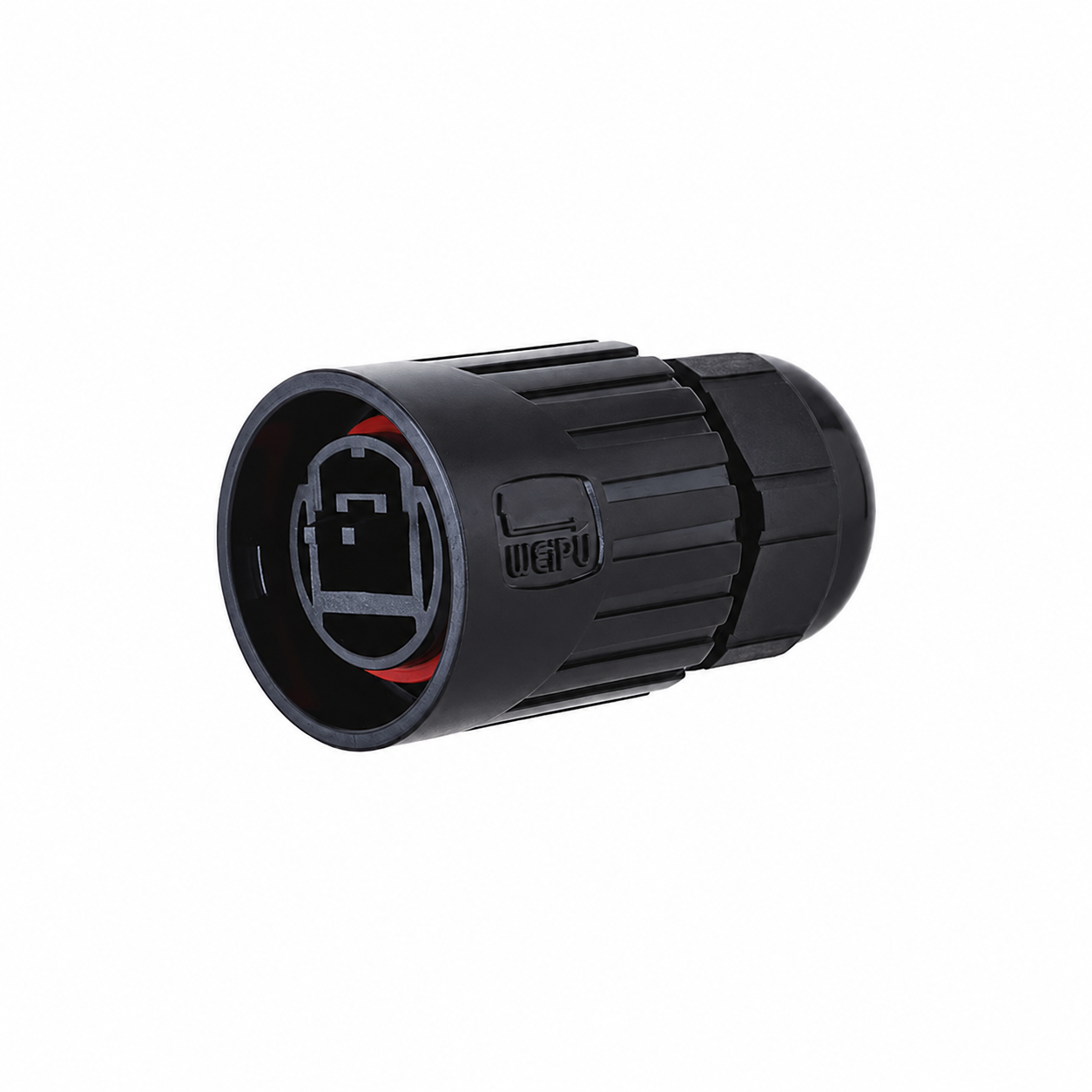
Shielding describes how the connection handles electromagnetic interference. A cabling category defines transmission limits over a range of frequencies. An IP rating describes protection against dust and water under specified test conditions. A buyer may need evidence for all three on the same cabinet port. The WEIPU RJ45F6II makes the distinction particularly clear: its size-II housing fits 6–7 mm cable, the series supports Cat 5e and Cat 6 cabling, and WEIPU specifies IP67 when mated. The exact-part marketplace listing identifies the connector as unshielded. WEIPU series drawings · Exact-part listing
Shielding depends on a continuous electrical path
In a balanced pair, the receiver measures the difference between the two conductors. Twisting helps expose them similarly to external fields. A conductive foil or braid can add protection near drives, motors and power cables. In a screened system that protection depends on how the cable screen meets the plug shield, the mating socket and the equipment bonding arrangement. Follow the equipment manufacturer's bonding design.
| Requirement | Relevant evidence | Insufficient evidence |
|---|---|---|
| Screen continuity | Specified screen termination through the complete interface | A metal collar or foil cable alone |
| Cabling category | Passing report to the required link/channel limit | Cable-jacket category or link light |
| Ingress protection | Exact mated assembly, seals and stated test conditions | A family IP code applied to every state |
| Mechanical fit | Mating drawing and cable-entry size | RJ45 contact form alone |
A cable marked F/UTP has an overall foil around unscreened twisted pairs. U/UTP has neither an overall screen nor individual pair screens. Either marking can appear alongside a category designation. When specifying a screened channel, ask for the termination drawing and inspect the mating shield contacts. A metal collar, a foil cable or a bayonet lock on its own tells you little about the electrical path through the joint.
If errors appear when a nearby drive starts, compare port error counters in both operating states, inspect cable routing, then verify screen continuity along the cable itself. A simple DC test can find an alternative path through bonded panels even with an open cable screen. This is why a continuity beep between cabinets is weak evidence for a repaired screen. Fluke Networks on testing shield integrity
Cat 5e and Cat 6 describe the installed signal path
Cat 5e cabling is tested to 100 MHz and Cat 6 to 250 MHz. MHz describes the frequency range used in the cabling test. Ethernet speed in Mbit/s describes the data service. WEIPU lists Class D/Cat 5e and Class E/Cat 6 applications for RJ45F. A Cat 6 cable jacket or a working link light alone cannot certify the assembled channel. WEIPU series applications · Fluke Networks test parameters and frequencies
- Wire map checks connections and pair assignment. A split pair can have an apparently correct pin-to-pin sequence while each signal is carried on conductors from different twisted pairs. Use a tester that detects split pairs.
- Near-end crosstalk (NEXT) measures coupling from one pair into another at the transmitting end. Excessive untwist beside a new plug can cost margin. Keep the pair lay close to the contacts as the termination instructions specify. Fluke Networks on crosstalk and pair twists
- Return loss measures reflections from changes in impedance. A poor termination or a damaged cable section can create a discontinuity. When the wire map passes but a category test fails, inspect the last termination and use the tester's fault location if available.
For acceptance, specify which assembled channel or link is being measured, select the corresponding test limit and adapters, and retain the report. A successful file transfer answers a different question from how much transmission margin remains.
IP67 depends on the mating face and cable entry
In IP67, 6 denotes dust-tight protection and 7 denotes protection against temporary immersion under defined conditions. WEIPU states the RJ45 series rating applies when mated. The front seal depends on the correct receptacle, a sound sealing surface and a fully engaged outer coupling. The rear seal depends on compression around the intended jacket diameter. The same water found at the contacts can have entered at either location. WEIPU mated IP67 specification
| Finding | Investigate | Record after correction |
|---|---|---|
| Errors correlate with drive activity | Routing and specified shield/bonding path | Comparable operating-state error evidence |
| Wire map passes but category fails | Pair construction, termination and failing test parameter | Report with the agreed limit and adapters |
| Moisture at contacts | Mating seal, rear entry and panel seal | Identified entry path and applicable exposure |
| Problem appears after cable change | Jacket diameter, plug compatibility and pair layout | Exact replacement and assembly record |
An operating port left open during maintenance, a pressure-washed panel and a permanently immersed connection each pose different conditions. Specify the actual exposure, the approved protection while unplugged, and any required jet or chemical resistance separately. For a wet cabinet, also inspect the receptacle-to-panel seal and the inside of the enclosure before assigning the failure to the cable plug.
Three observations to take back to the machine
Errors that track drive operation point first to routing and shielding checks. A dry link that passes wire map but fails a Cat 6 test calls for a look at pair termination and the failing parameter. Moisture after cleaning calls for inspection of the mating face, rear gland and panel seal. These are starting hypotheses: record the evidence, correct one fault at a time and repeat the relevant acceptance test. Use the field replacement checklist
Need help selecting? Send photos of the model, nameplate and installation; quantity may be unknown.
Related reading
Replacing an industrial RJ45 plug in the field
Use the WEIPU RJ45F6II to check the mating port, cable diameter, shielding and seal before replacing an industrial Ethernet plug.
Read article →