
Ultrasonic Sensing Limits: Blind Zone, Echo Geometry and Response Time
Connect time of flight to distance, distinguish echo travel time from output response, and investigate missing or unstable readings with a structured test record.
Need help selecting? Send photos of the model, nameplate and installation; quantity may be unknown.
An ultrasonic distance sensor measures an acoustic echo, not a geometrically perfect line to every surface in front of it. Its reading depends on when a usable echo returns, which object returns it and how the electronics process that information.
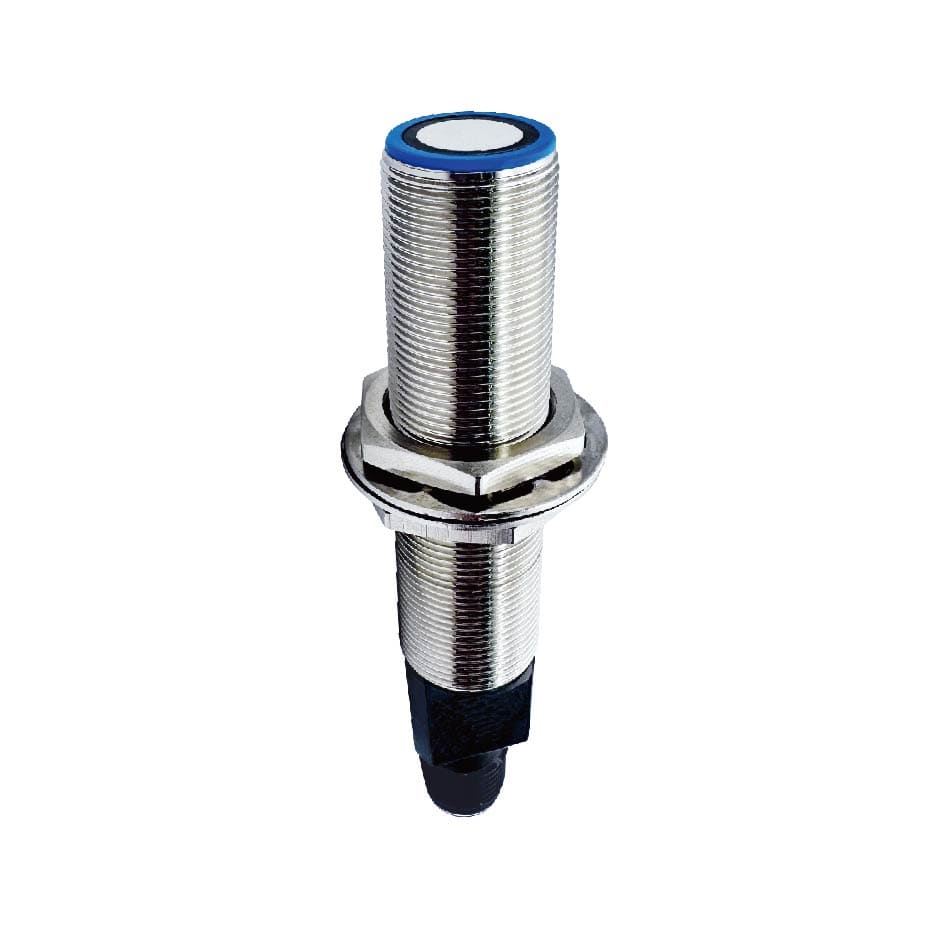
Time of flight is only part of the measurement cycle
For a single round trip, distance = speed of sound × travel time ÷ 2. Using an assumed sound speed of 343 m/s, a target 0.5 m away produces about 2.9 ms of round-trip travel time. That calculation does not give the sensor's total response time: transmission, receiver recovery, processing, filtering and output updates also matter.
Immediately after transmitting, the transducer needs time to settle. A sufficiently close echo may arrive before the measurement system can use it. The resulting near blind zone is a physical operating limitation; moving a taught threshold does not make an invalid close echo reliable.
| Quantity | What it means | Incorrect inference |
|---|---|---|
| Echo travel time | Acoustic round-trip delay | Treating it as complete sensor response |
| Blind zone | Near region outside usable detection | Assuming a taught setpoint removes it |
| Response or update time | Timing of the specified output behaviour | Assuming every brief event is captured |
| Beam or response curve | Detection behaviour for stated targets | Treating it as a sharp universal cone |
| Analog scaling | Mapping from distance to output | Assuming endpoints equal the full sensing limits |
Target orientation can change which echo wins
A broad surface facing the sensor can return a stronger useful echo than the same surface tilted away. A bracket or wall may then become a competing reflector. The manufacturer's response curve must be interpreted with its target size and test conditions; it is not a guarantee for every shape within a drawn outline.
Compare the actual target at its expected angles and include the empty station. If the reading becomes stable only when the target is removed, investigate the background rather than assuming the output represents the target position.
Motion creates a limited observation window
A target moving at 0.5 m/s through a 20 mm usable observation window is present for 40 ms. This illustrative dwell time must be considered alongside sensor response, filtering and the controller input processing. A smooth analog reading after the target stops cannot prove that the same system captures the moving event.
| Observation | Hypothesis | Discriminating check |
|---|---|---|
| No valid reading very close to the face | Near blind-zone limitation | Actual face-to-target distance |
| Reading changes with target tilt | Echo redirected away from the receiver | Repeat with controlled orientation |
| Empty station produces a stable distance | Background reflection | Map nearby walls, brackets and fixtures |
| Works stationary but misses in motion | Insufficient observation or response time | Dwell time and full input chain |
| Several sensors disturb each other | Acoustic interaction | Manufacturer-approved spacing or synchronisation review |
For the BEDOOK UM18 analog and switching candidates, obtain the exact variant's range, response, wiring and invalid-echo behaviour. Do not transfer settings between them from the shared M18 housing. Record target geometry, mounting position, output configuration and controller interpretation together so a later replacement can reproduce the accepted measurement conditions.
Product and technical references
- M18 Ultrasonic Distance Sensor, 4–20 mA — UM18-T10I-C31S12-X
- M18 Ultrasonic Switching Sensor, 70–1000 mm — UM18-T10P-C31S12-X
Pepperl+Fuchs ultrasonic sensing modes Catalog source for the example
Read the field selection guide
Need help selecting? Send photos of the model, nameplate and installation; quantity may be unknown.
Related reading
Choosing an M18 Ultrasonic Sensor: Switching Output, 4–20 mA and Blind Zone
Choose the PLC interface and check both ends of target travel before ordering. Compare BEDOOK UM18 examples with a mounting and procurement checklist.
Read article →