
Why Robot Dress Packs Twist, Pull Tight and Wear: A System-Level Diagnosis
Separate bending, torsion and changing free length. Relate wear patterns to supports, retraction travel and the individual cables inside the pack.
Need help selecting? Send photos of the model, nameplate and installation; quantity may be unknown.
A dress pack can look neat while a cable inside is overloaded. The outer conduit, internal media, supports and return mechanism share the same motion but do not necessarily experience the same load. Diagnose the system through its full movement instead of judging a parked loop.
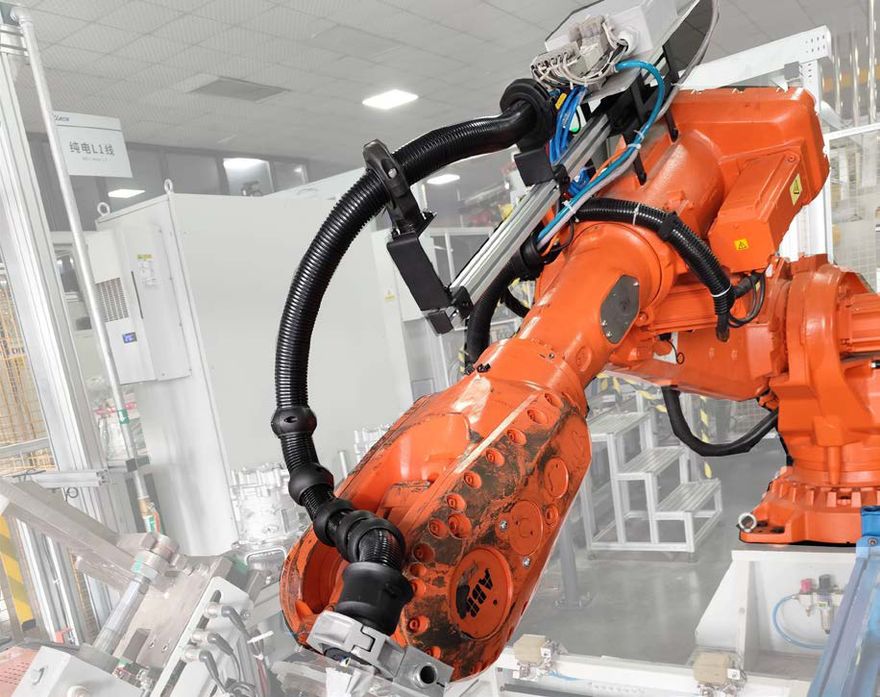
Bending and torsion are different movements
Bending changes the direction of a line's centreline. Torsion rotates its cross-section along its length. A generous bend radius does not remove twist introduced between two restrained ends. An approved longitudinal reference mark can help reveal rotation during a controlled movement review.
As a simplified comparison, distributing 90 degrees of rotation over one metre gives an average 90 degrees per metre. Concentrating it in 0.25 m gives 360 degrees per metre. Actual twist may be nonuniform, and these values are not product allowances. They explain why the available free length and restraint positions matter.
| System element | What it controls | What it cannot establish alone |
|---|---|---|
| Conduit | Bundle protection and route envelope | Suitability of each internal cable for torsion |
| Fixed support | Where movement starts or ends | Correct slack elsewhere |
| Sliding or rotating guide | A permitted local movement | Unlimited movement or friction-free operation |
| Retractor | Storage of changing free length | Correction of unsuitable cable construction |
| End restraint | Mechanical load transfer | Electrical compatibility or correct wiring |
Retraction travel and force must be assessed together
A return mechanism takes up excess length. If it reaches its stop before maximum reach, further robot movement must be accommodated elsewhere, potentially by the conduit, clamps or connections. At the other extreme, insufficient take-up can leave a loop in the fixture envelope.
Increasing return force is not a universal cure. It may overcome friction while increasing the load on supports or the shortest internal line. Check the intended force–travel relationship, internal slack and strain relief before adjusting the mechanism. igus presents retraction as a configured part of the dress-pack system, not an independent guarantee of cable life.
Read the two ends of the movement
| Observation | Hypothesis | Evidence to collect |
|---|---|---|
| Tight at maximum reach | Insufficient usable length or retractor travel | Remaining travel and tension location |
| Large loop on return | Inadequate take-up, friction or wrong route | Return behaviour and support positions |
| Stripe winds around the bundle | Torsion between restraints | Rotation distribution along the free length |
| Local polished patch | Repeated contact | Opposing surface and associated robot pose |
| Kink at a cuff or support | Abrupt transition or local radius | Exit angle and nearby constraints |
| One line fails repeatedly | Internal length or construction mismatch | Individual route, restraint and motion rating |
The Leinuoer GP8, ABB and FANUC configurations are different application references. A successful route on one robot does not qualify the others. Compare the actual tool, fixture and cycle before adopting its layout.
Record the original configuration and change one justified variable at a time. Recheck the complete required cycle after changing a support or length, because relieving one pose can worsen another. Keep accepted poses, bundle contents and adjustment settings with the final configuration drawing.
Product and technical references
- Fixed direct-exit Dress Pack for YASKAWA GP8
- Third-party axis-3 height-adjustable dress pack for ABB robots
- Spring-return Dress Pack for FANUC R-2000iC-165F&210F
igus robot dress-pack retraction systems Catalog source for the example
Read the field selection guide
Need help selecting? Send photos of the model, nameplate and installation; quantity may be unknown.
Related reading
How to Specify a Robot Dress Pack: Routing, Retraction and Cable Load
Compare fixed routing and retracting layouts using the actual robot path, cable bundle and tool interface. Includes a system specification and supplier handover checklist.
Read article →