
How to Specify a Robot Dress Pack: Routing, Retraction and Cable Load
Compare fixed routing and retracting layouts using the actual robot path, cable bundle and tool interface. Includes a system specification and supplier handover checklist.
Need help selecting? Send photos of the model, nameplate and installation; quantity may be unknown.
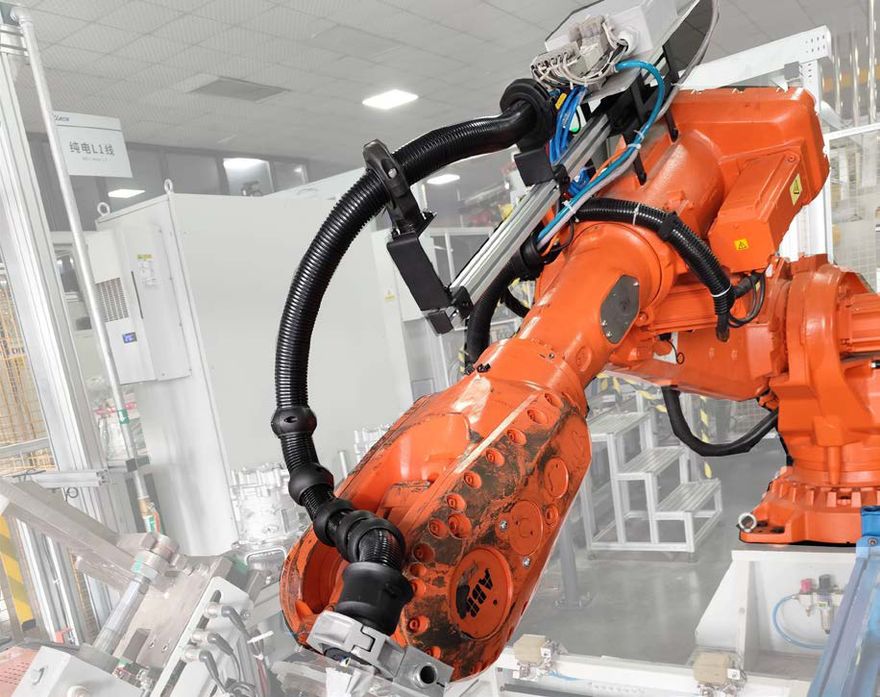
A robot dress pack carries cables and hoses between the robot base, arm and tool while controlling their movement. It combines conduit, supports, guides and, where required, a return mechanism. Choosing the robot model starts the configuration; the movement and media requirements complete it.
Start with the movement and the media list
Give the supplier the complete robot designation, mounting orientation, tool arrangement and axes covered. Base-to-arm and wrist sections face different movements. Include the tool changer, welding equipment or gripper fittings occupying the same space.
List every cable and hose with its outside diameter, connector envelope, required bend radius and motion rating. A fitted connector can dictate assembly access even when the cable itself fits easily. State any separation requirements for air, coolant and electrical services before choosing conduit size.
Use a representative cycle or approved motion simulation to show both the longest extension and the position where excess length gathers. A straight measurement with the robot parked does not describe the moving envelope.
Compare layouts by the problem they solve
| Layout or component | Question it addresses | Evidence needed before selection |
|---|---|---|
| Fixed routing | Can the planned loop accommodate motion without active retraction? | Route at critical positions and available clearance |
| Spring-return arrangement | Does excess length need to be taken up as the wrist moves? | Required travel, return-force range and cable loading |
| Guide or rotating support | Where must the bundle change direction or orientation? | Intended movement and interface drawing |
| Conduit and separation | Can all media move without excessive crowding or rubbing? | Bundle contents, fill recommendation and bend requirements |
| End restraint | Where are loads transferred away from connectors? | Strain-relief details and replacement access |
The listed Leinuoer fixed direct-exit configuration for YASKAWA GP8 is one routing reference. The FANUC spring-return example and ABB support arrangement describe different configurations. Their pictures do not establish interchangeability, and their conduit sizes should not be transferred to another robot without reviewing its bundle and movement.
Review clearance throughout the cycle
Check the wrist at its most rotated and folded positions, including fixture approaches and normal service positions. Look for contact with the arm, snagging at a bracket and a return unit reaching its travel limit.
If the route rubs a sharp edge or pulls a connector, first review the route, support position and available length. Adding a protective sleeve does not remove those causes. Ask the system supplier to identify the accepted movement envelope and restrictions in the quotation.
Procurement and acceptance checklist
| Deliverable | Ask the supplier to include | Acceptance question |
|---|---|---|
| Configuration drawing | Robot, axes, supports and tool interface | Does it match the actual cell? |
| Bill of materials | Conduit, guides, brackets, adapters and return mechanism | Are cables and hoses included? |
| Installation scope | Assembly access, insertion and adjustment procedure | Can existing connectors pass through? |
| Operating limits | Permitted motion, travel and media requirements | Are critical cycle positions covered? |
| Service parts | Replaceable inserts, sleeves, springs and codes | Can maintenance order parts individually? |
| Commissioning record | Route photographs and agreed movement checks | Is there contact, tension or bottoming? |
Commission the installed system using the robot manufacturer's procedures and the cell's safe commissioning process. Record final adjustments and critical positions. An installation photograph provides context; the approved configuration and completed movement review define what was accepted.
Product and technical references
- Fixed direct-exit Dress Pack for YASKAWA GP8
- Third-party axis-3 height-adjustable dress pack for ABB robots
- Spring-return Dress Pack for FANUC R-2000iC-165F&210F
igus robot dress-pack retraction systems Catalog source for the example
Need help selecting? Send photos of the model, nameplate and installation; quantity may be unknown.
Related reading
Why Robot Dress Packs Twist, Pull Tight and Wear: A System-Level Diagnosis
Separate bending, torsion and changing free length. Relate wear patterns to supports, retraction travel and the individual cables inside the pack.
Read article →