
How to Select a Multi-Axis Robot Cable Carrier
Check three-dimensional movement, usable cable space and end restraints before choosing a side-opening carrier. Includes route and procurement checklists.
Need help selecting? Send photos of the model, nameplate and installation; quantity may be unknown.
A robot cable carrier guides a moving bundle through a defined range of motion. Selection starts with the complete route and the cables inside it, not just the outside appearance of the carrier. The carrier, its end brackets and the internal lines all need compatible movement limits.
Describe the motion in three dimensions
For each section, record the bending direction, wrist rotation, free length and the space swept during movement. Include the most extended and most folded robot positions, tool changes and the return route. A straight-line cable-tray dimension does not describe a multi-axis robot path.
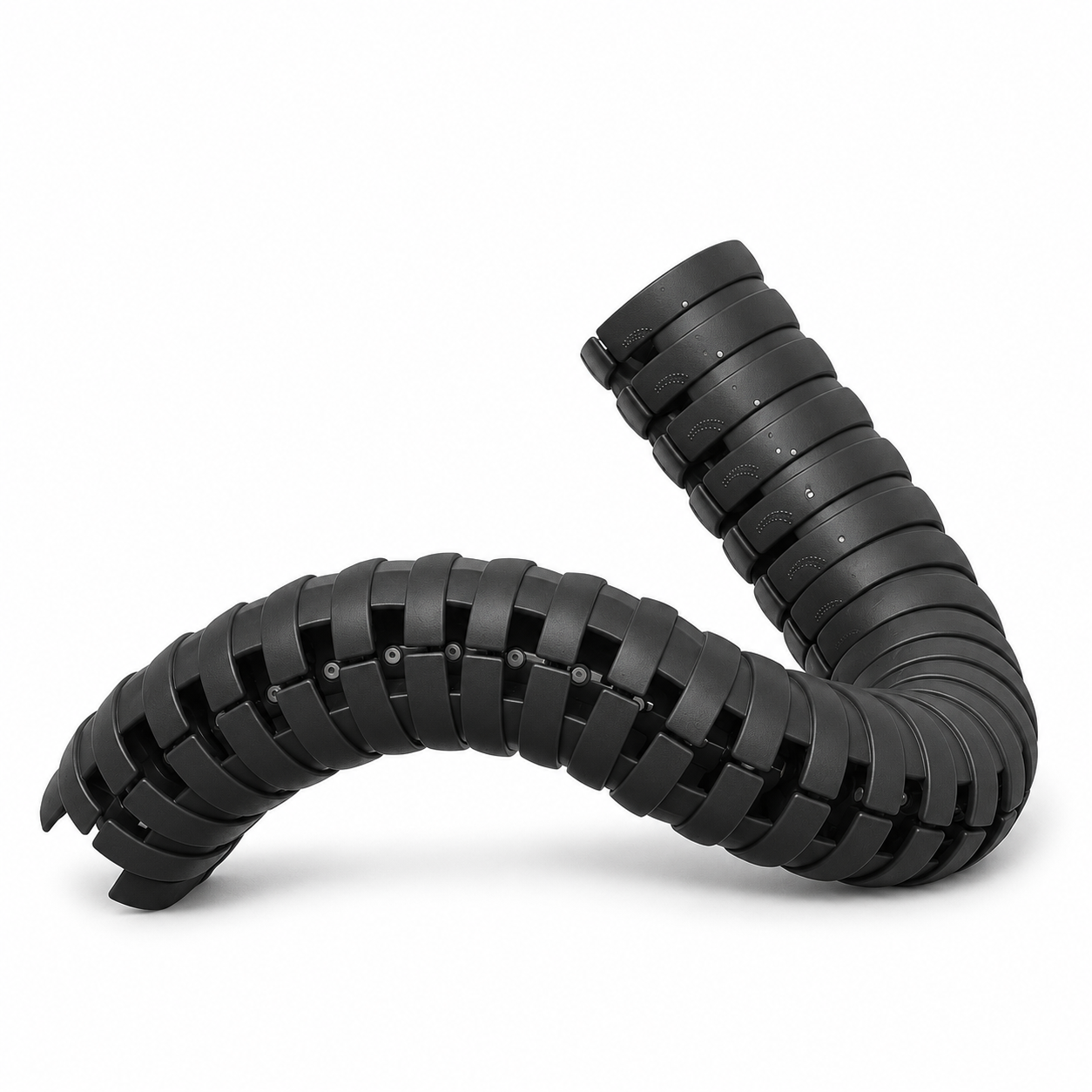
The WINLINKS side-opening carrier is a catalogue candidate when a terminated bundle must be loaded without passing connectors through a closed tube. Confirm the usable opening, link closure and available end hardware with the supplier. An opening feature does not establish the permissible bend, twist or load.
| Selection input | Check against the proposed carrier |
|---|---|
| Cable and hose list | Individual diameters, weights and moving bend/twist limits |
| Route and motion extremes | Bend planes, rotation and available swept space |
| Existing connectors | Assembly access and whether side loading is possible |
| Internal arrangement | Usable space, separation and freedom of movement |
| End interfaces | Bracket identity, attachment and strain relief |
Leave room for the lines to work
Measure each cable and hose instead of estimating the bundle by eye. Ask how lines should be arranged and separated in this particular carrier. The igus cable-and-hose guidance discusses fill, separation and movement for its systems; apply the selected manufacturer's instructions rather than copying a universal fill percentage to an unrelated design.
Check both the carrier's minimum bend radius and the more restrictive limit of any line inside. Increasing the carrier size does not automatically fix a tight exit or a cable already twisted during assembly. Include connector exits and transition sections in the route review.
Keep the quotation complete
| Provide with the enquiry | Request on the quotation |
|---|---|
| Annotated route photographs and motion data | Exact carrier family and configuration |
| Full media list and their limits | Proposed internal arrangement and separation |
| End mounting drawings | Brackets, inserts and strain-relief components |
| Exposure, cleaning and service access | Relevant materials and service restrictions |
| Length, quantity and required date | Length basis, spare links and supplied accessories |
Define how the quoted length is measured. Ask whether terminal links and brackets are included and whether the assembly can be serviced without removing the complete bundle. For a replacement, retain the existing carrier code and identify any requested change separately.
Commission the loaded assembly
Have the machine team review the fully loaded carrier under the approved commissioning procedure. Observe link articulation, contact with nearby equipment, cable movement at the exits and tension at connectors. A demonstration with an empty carrier is not acceptance of the completed installation.
Document the final arrangement and any limits agreed by the integrator. If tools or media change later, repeat the route and filling review. The accepted carrier code is only one part of the configuration that produced a workable installation.
Use Discuss your requirements to send the route, media list and end-mounting photographs.
Product and technical references
igus cable and hose installation guidance Catalog source for the example
Need help selecting? Send photos of the model, nameplate and installation; quantity may be unknown.
Related reading
Selecting XINGYI Cable Drag Chains: 15 × 20 and 18 × 25 mm Interiors
Compare internal space, outer envelope and the shared 38 mm bend radius for compact cable routes.
Read article →XINGYI Drag Chain Installation Reference: Routing, Clearance and Inspection
A dimensional installation checklist for reinforced-nylon drag chains with a 38 mm bend radius.
Read article →Cable Wear Inside Moving Carriers: Bend Radius, Separation and Torsion
Explain why an apparently roomy carrier can still damage cables, how internal paths change in a bend, and which wear patterns guide an investigation.
Read article →