
Selecting XINGYI Cable Drag Chains: 15 × 20 and 18 × 25 mm Interiors
Compare internal space, outer envelope and the shared 38 mm bend radius for compact cable routes.
Need help selecting? Send photos of the model, nameplate and installation; quantity may be unknown.
Start with the cable route
Selecting a cable drag chain begins with the cables and hoses that must move, the travel path and the space available around that path. The XINGYI models in this guide provide two internal sizes in reinforced nylon. Both have a listed bend radius of 38 mm, so choosing the larger interior does not change that radius.
Prepare a cable schedule before selecting the chain. Record each cable's outside dimensions, intended moving duty and applicable bending requirements. Add the actual route, fixed and moving attachment locations, and any obstacles that the assembled chain must pass.
Compare the chain dimensions
| Model | Internal height × width (mm) | External height × width (mm) | Bend radius R (mm) | Material |
|---|---|---|---|---|
| XY-DC-0001 | 15 × 20 | 20 × 30 | 38 | Reinforced nylon |
| XY-DC-0002 | 18 × 25 | 23 × 36 | 38 | Reinforced nylon |
XY-DC-0001 offers a 15 × 20 mm interior inside a 20 × 30 mm external section. XY-DC-0002 increases the interior to 18 × 25 mm and the external section to 23 × 36 mm. Check internal packing and external clearance separately; the extra internal space also requires a larger route envelope.
Review the cable arrangement
Lay out the cable cross-sections inside the proposed interior and allow room for movement. Inspect differences in diameter and jacket behaviour rather than treating the available rectangle as completely usable packing area. Where separation is required, include the specified separating arrangement in the application review.
The cable or hose manufacturer's bending requirement must be compatible with the route. Also plan strain relief so the moving arrangement does not transfer unintended tension to the cable terminations. These are general cable-carrier design principles, described in manufacturer guidance on carrier filling and bending.
Evaluate the full moving envelope
Place the chain route on the machine drawing, including the curved return and both attachment locations. Check the envelope at the travel limits and intermediate positions. Nearby brackets, covers and fasteners can create interference even when a straight chain section fits between them.
Determine assembled length from the actual route and the specified chain configuration. Keep the required attachment arrangement and length in the enquiry so the supplied assembly can be checked against the installation. A cross-section and bend radius alone do not describe the complete installed chain.
A practical selection sequence
- List the cables and hoses with their dimensions and moving-use requirements.
- Compare the two interiors using the proposed cable arrangement and necessary movement space.
- Check the 38 mm chain radius against every cable or hose requirement in the bundle.
- Check the external section and complete moving route against the machine envelope.
- Define the required assembly length and attachments, then trial the installation under controlled conditions.
If the smaller interior cannot accommodate the planned arrangement, review XY-DC-0002 and its larger outer dimensions. If the bending requirement is incompatible with the 38 mm radius, increasing the interior size within these two models does not resolve that issue.
Inspect the completed route
Before normal operation, move the mechanism slowly through its intended travel and watch the cable arrangement at the bend, attachment points and surrounding structure. Look for trapped cables, rubbing, unexpected tension or chain contact. Record the accepted route and cable layout for future replacements. Dimensional selection is complete only when the installed arrangement has been checked throughout its intended movement.
Browse the XINGYI category and product details to compare the listed models and prepare your dimensional enquiry.
Need help selecting? Send photos of the model, nameplate and installation; quantity may be unknown.
Related reading
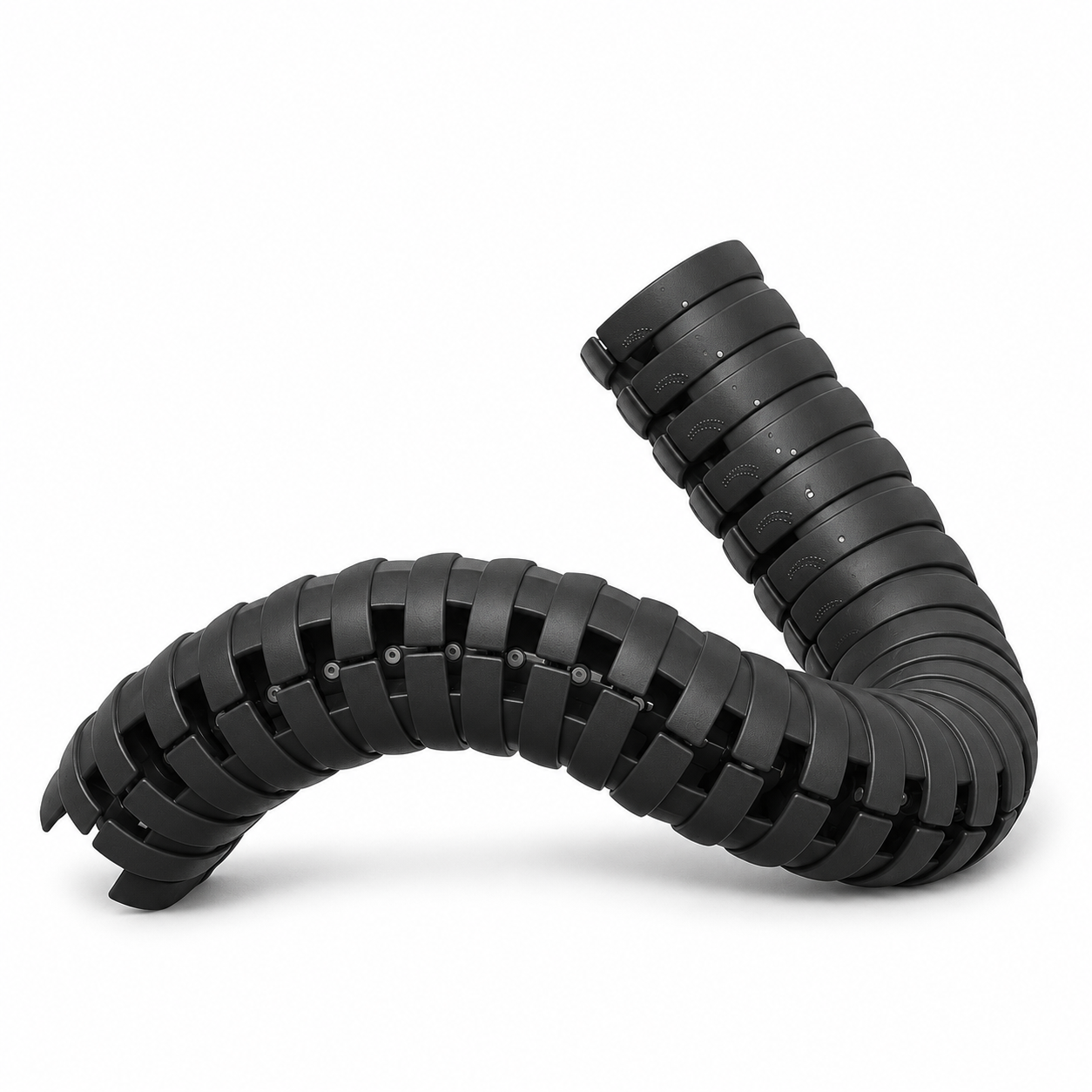
How to Select a Multi-Axis Robot Cable Carrier
Check three-dimensional movement, usable cable space and end restraints before choosing a side-opening carrier. Includes route and procurement checklists.
Read article →XINGYI Drag Chain Installation Reference: Routing, Clearance and Inspection
A dimensional installation checklist for reinforced-nylon drag chains with a 38 mm bend radius.
Read article →Cable Wear Inside Moving Carriers: Bend Radius, Separation and Torsion
Explain why an apparently roomy carrier can still damage cables, how internal paths change in a bend, and which wear patterns guide an investigation.
Read article →