
4 mm vs 8 mm inductive sensors: flush mounting and sensing distance
See where to measure the air gap, how surrounding metal affects detection, and why rated and assured distances differ. Includes BEDOOK and LANBAO M12 examples.
Need help selecting? Send photos of the model, nameplate and installation; quantity may be unknown.
What do 4 mm and 8 mm actually measure?
They are rated sensing distances for specified test conditions. For an axial approach, the reference is the active face and the target surface directly opposite it. A stationary mounting nut beside the sensor is outside that measurement, yet its position can still affect the switch. The gap and the clearance around the head answer two separate engineering questions.
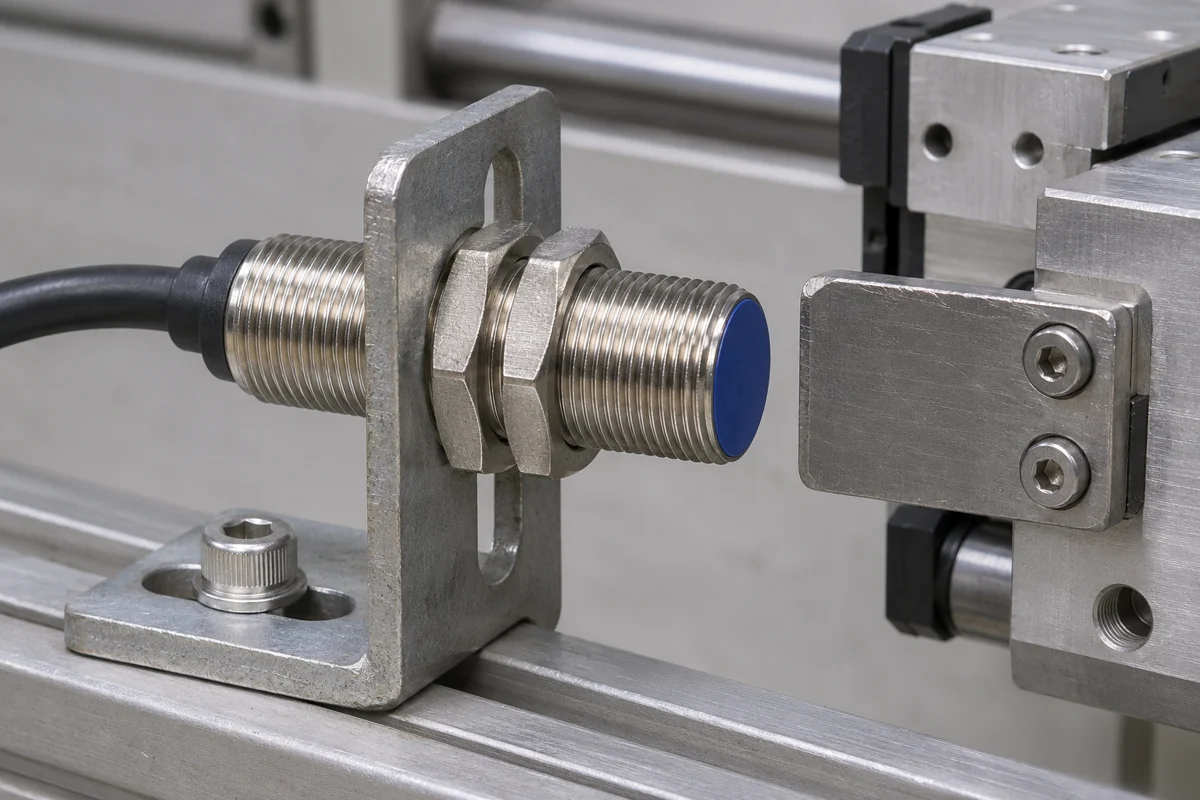
Why does a metal bracket matter?
The sensing coil creates an alternating magnetic field. A conductive target entering the field develops eddy currents, changing the oscillator response until the switch changes state. Nearby metal can also load that field. A flush design concentrates the useful field in front so the housing can be embedded in metal in the specified arrangement. A non-flush design allows more field to extend sideways and needs a defined metal-free zone. An enclosing bracket can shift the switching point or leave the output active with the intended target absent. OMRON technical guide to shielded and unshielded sensors
| Mounting description | Requirement to establish | Why the distinction matters |
|---|---|---|
| Flush | Permitted embedding arrangement for the exact model | Surrounding metal is part of the installation condition |
| Quasi-flush | Specified face projection or metal setback | It is not automatically identical to flush |
| Non-flush | Required metal-free zone around the sensing head | An enclosing bracket can affect operation |
Quasi-flush is a model-specific mounting condition. BEDOOK lists BB-M1204P-C11S12 as flush. LANBAO calls LR12XBF04DPOY-E2 quasi-flush. Both carry a 4 mm nominal rating. For a retrofit, compare the specified setback and the installation drawing for the actual part number. The length of a plastic cap in a product photo is insufficient to establish a clearance. BEDOOK mounting groups and LANBAO model matrix
Rated distance versus assured operating range
LANBAO's LR12X sheet gives two useful pairs of figures. For the 4 mm quasi-flush version the assured range is 0–3.2 mm, measured with a specified 12 × 12 × 1 mm iron target. For the 8 mm non-flush version it is 0–6.4 mm, with a 24 × 24 × 1 mm iron target. The nominal range doubles, but the reference target also grows. These figures belong to those LR12X variants. The zero on the graph is the measurement origin; leave mechanical clearance for motion, tolerances and vibration. LANBAO LR12X manufacturer data sheet
| LANBAO LR12X variant in cited sheet | Rated distance | Assured range | Reference iron target |
|---|---|---|---|
| 4 mm quasi-flush | 4 mm | 0–3.2 mm | 12 × 12 × 1 mm |
| 8 mm non-flush | 8 mm | 0–6.4 mm | 24 × 24 × 1 mm |
A practical consequence. Suppose the target is a narrow aluminium lug passing 5 mm away. The 8 mm figure by itself cannot establish that the lug will operate the switch. Its material and area differ from the iron reference plate. Ask for the model's material factor and target-size guidance, or test a representative lug with the intended bracket. If it passes sideways across the face, record lateral overlap as well as the air gap: it may enter the sensing field only briefly.
Why can the LED switch on and off at different gaps?
As a target approaches, the output turns on at one point. As the target retreats, it releases at another. The separation is hysteresis. It helps prevent repeated switching during small movements close to the threshold. Repeatability describes the variation over repeated approaches under the same conditions. A sensor that repeats very consistently can still have a release point noticeably different from its operate point. For a moving flag, check the input resets between consecutive targets. OMRON definitions of hysteresis and sensing distance
Two ways a longer-range replacement can change the machine
The output may differ. The two BEDOOK examples are both PNP normally open, making them useful for isolating the mounting question. The two LANBAO products in this catalog differ electrically: LR12XBF04DPOY-E2 sources current through a PNP output; LR12XBN08DNOY-E2 sinks current through an NPN output. Both being normally open tells you their resting switching logic. It does not tell you which PLC input circuit will work. LANBAO ordering matrix
The speed limit may differ. BEDOOK lists 3,000 Hz for its 4 mm BB connector version and 500 Hz for its 8 mm BN connector version. These are test ratings. For a wheel with short steel flags, consider flag width, speed, time between flags and the input module's filter time. A high sensor frequency alone cannot ensure the PLC sees every pulse. BEDOOK switching frequencies by model
To qualify an alternative, capture the part number, surrounding metal, real target, maximum working gap and input circuit together. Use the replacement selection guide to turn those observations into an enquiry.
Need help selecting? Send photos of the model, nameplate and installation; quantity may be unknown.
Related reading
How to choose a replacement M12 inductive proximity sensor
Match the mounting, target gap and PLC input before ordering. Compare four catalog models rated at 4 mm or 8 mm, including flush, quasi-flush and non-flush designs.
Read article →