
Robot Harness Breakouts: Why Branch Position Matters as Much as Total Length
Trace mechanical load through a branched harness, distinguish routing faults from electrical mismatches, and define evidence for a replacement assembly.
Need help selecting? Send photos of the model, nameplate and installation; quantity may be unknown.
A robot harness is a three-dimensional assembly. Two harnesses can have the same overall length and connector count but behave differently because their breakouts, branches and restraints sit in different places. Continuity and geometric fit therefore need separate acceptance checks.
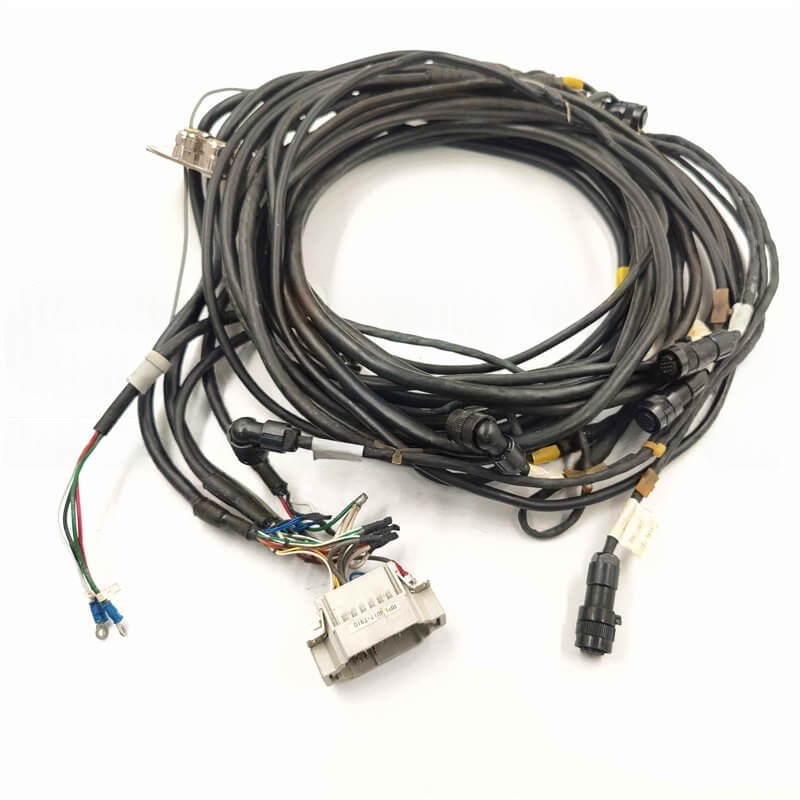
The breakout is part of the moving geometry
The trunk passes between supports while each branch reaches its own connection. If a breakout shifts across a clamp position, a branch may have to absorb movement previously carried by the trunk. A connector can then be loaded even though the replacement appears long enough on a bench.
Consider a branch with a fixed connector location. Moving its breakout 50 mm farther away along the route consumes available length in that direction, but does not necessarily add exactly 50 mm to the required branch length: bends and the installed path also change. Measure the routed distance from the same reference points rather than applying a single overall correction.
| Geometric feature | What it defines | Consequence of an unchecked change |
|---|---|---|
| Trunk reference length | Main route between defined endpoints | A matching number can hide different measurement datums |
| Breakout position | Where each branch leaves the trunk | Load moves into a branch or connector |
| Branch length | Reach along the actual route | Tension if short; snagging if excessive |
| Connector orientation | Exit direction after mating | Local twist or reduced clearance |
| Restraint position | Where mechanical loads are transferred | Unintended movement at the termination |
Electrical equivalence is a separate question
The supplier's A660-8017-T909 cross-reference identifies the proposed FANUC J1–J6 assembly. It is a useful starting identity, but it does not independently supply a verified branch map, conductor rating or pin schedule for every variant.
Request the drawing revision, point-to-point map and required construction. A connector shell that mates correctly can still contain different circuits. Conversely, a correct wiring map does not establish whether the jacket and internal construction can withstand the required motion.
Use the symptom to choose the investigation
| Observation | Possible mechanical or electrical cause | Evidence to compare |
|---|---|---|
| Contact begins to back out | Connector or branch carrying tension | Route at maximum reach and retention inspection |
| Whitening or cracking near breakout | Concentrated bending or material exposure | Local curvature, temperature and service conditions |
| Fault appears only at one pose | Intermittent conductor or connection | Fault time correlated with position |
| New branch catches a fixture | Excess length or changed exit direction | Swept path through the cycle |
| Bench continuity passes but operation fails | Circuit construction or intermittent fault not covered | Approved electrical tests and actual option configuration |
A replacement investigation should preserve the old harness identity and failure location before disassembly, where safe and practical. Compare the new assembly laid out from consistent reference points, then review the installed geometry with the real supports.
For acceptance, retain both the electrical test report and the as-installed branch map. If a field repair changes a connector or breakout, record the change rather than allowing the next supplier to reproduce an undocumented hybrid. ABB PMA protection guidance is relevant to routing and protection; the harness's exact electrical specification must come from the equipment and assembly documentation.
Product and technical references
ABB PMA robotic cable protection Catalog source for the example
Read the field selection guide
Need help selecting? Send photos of the model, nameplate and installation; quantity may be unknown.
Related reading
Identifying a Replacement Robot Wiring Harness: Endpoints, Branches and Routing
Build a connector-to-connector branch schedule before requesting a replacement. Includes a FANUC A660-8017-T909 cross-reference example and a supplier verification checklist.
Read article →