
Fixed Clamps and Sliding Guides: How Bracket Position Changes Dress-Pack Loads
Distinguish anchoring, sliding and rotation, then use wear location and movement observations to investigate concentrated bending and guide friction.
Need help selecting? Send photos of the model, nameplate and installation; quantity may be unknown.
A support bracket does more than hold a tube above the robot. It defines which movements are allowed at that point. Fixing a location that should slide, or allowing movement at an intended anchor, changes where the rest of the dress pack bends and transfers force.
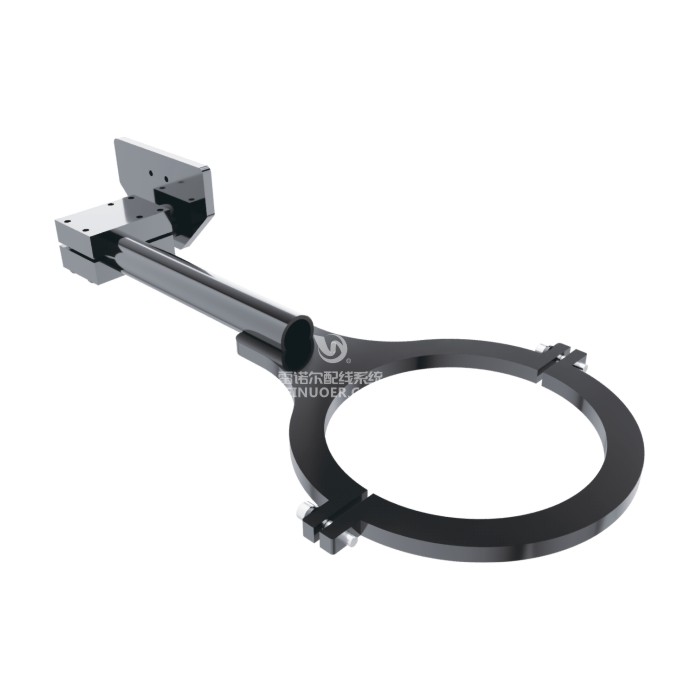
Identify the intended degree of movement
A corrugation-gripping insert can anchor a tube. A smooth guide may allow translation. A swivel can change orientation. These functions can be combined in an assembly, but they are not interchangeable descriptions of a bracket with a round opening.
Use the manufacturer's assembly drawing to establish intended movement, then compare it with the installed behaviour. A temporary reference mark on an approved surface can help relate tube movement to the support during a controlled commissioning check. Do not infer a fault from movement that the design intentionally permits.
| Support function | Intended behaviour | What an incorrect substitution can do |
|---|---|---|
| Fixed anchor | Holds the specified tube location | An unintended sliding replacement can lose route control |
| Sliding guide | Allows defined movement through the support | A gripping insert can concentrate bending or tension |
| Rotating support | Allows the holder to change orientation | A fixed substitute can introduce side load |
| End restraint | Transfers load away from terminations | An ineffective restraint can load individual conductors |
A shorter free span has less space to change direction
Between two supports, the conduit must accommodate the relative movement of the robot links. Moving a bracket closer to the next constraint reduces the length over which that change can occur. Local curvature may increase, especially at the guide exit, even if the overall route looks tidier.
A nominal tube diameter does not establish the actual sliding clearance. Insert material, profile, alignment and the tube's surface condition affect contact. A damaged edge can scrape the jacket; excessive side load can make a correctly sized guide resist movement.
HELU distinguishes several dress-pack support and protection components. That system view is useful: assess the bracket with its insert and adjacent supports, not as an isolated ring. Specific permissible motions and loads still come from the chosen assembly's documentation.
Separate a wear observation from its cause
| Wear or behaviour | Plausible explanation | Check before replacing the bracket |
|---|---|---|
| Ring-shaped mark near an exit | Concentrated contact or bending | Insert profile, alignment and local radius |
| Long polished stripe | Repeated sliding against a surface | Where contact occurs over the cycle |
| Stop-start sliding | Friction, contamination or misalignment | Guide condition and side loading |
| Tube shifts from its original location | Wrong anchoring function or retention | Required movement and original reference position |
| New wear after repositioning | Changed span or approach angle | Before/after geometry at critical poses |
Document the affected robot pose and inspect both the tube and support. Changing several bracket positions at once makes it difficult to tell which change helped. After a justified adjustment, review the complete required movement range and save the accepted position relative to a stable robot feature.
A successful empty-arm movement check does not cover a heavier or differently filled bundle. Include the production cable and hose arrangement when confirming the final support configuration.
Product and technical references
HELU dress-pack components Catalog source for the example
Read the field selection guide
Need help selecting? Send photos of the model, nameplate and installation; quantity may be unknown.
Related reading
Fixed Clamp or Sliding Guide? Selecting Robot Dress-Pack Supports
Decide which movement each support must allow, then specify the bracket, insert and mounting interface. Includes a comparison table and installation enquiry checklist.
Read article →