IEC 60309 clock positions and IP44 explained
Read 6h on an industrial socket face, see how the key and earth contact block a mismatch, and judge splash exposure using the WEIPU TYPR231 as an example.
Need help selecting? Send photos of the model, nameplate and installation; quantity may be unknown.
An industrial plug marking combines several independent requirements. Read pole arrangement, current, voltage, frequency and clock position together, then assess ingress protection in the actual connected or disconnected state.
What does 6h mean on an industrial plug?
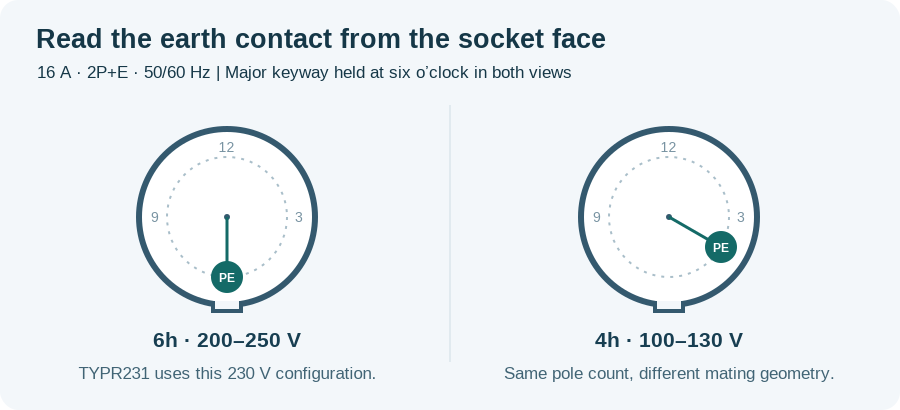
6h identifies the angular position of the protective-earth contact relative to the main keyway. For this type of connector, read the standard drawing looking into the mating face of the socket, with the major keyway at six o’clock. On the 6h pattern the earth contact sits on the same radial line as the keyway. Turning the entire socket sideways on a cabinet leaves that relationship unchanged. SCAME clock-face convention
How the geometry prevents a wrong connection
The plug and socket can begin to engage only in the orientation permitted by the key and keyway. With those guides aligned, the larger protective-earth pin must enter its matching contact tube. Change its angular position and the contact pattern no longer lines up. Rotating the plug to align the earth contact also moves the key away from its keyway. For a mismatch, identify the correct mate and leave the key and contacts intact. MENNEKES contact positions and voltage table
Compare two 16 A, 2P+E, 50/60 Hz configurations. The 200–250 V pattern used for the 230 V WEIPU TYPR231 is 6h. The 100–130 V pattern in the same pole group is 4h. Both have three contacts. Fix the keyway at the bottom and the second earth contact is visibly off to the right. Looking at the front of a loose male plug reverses left and right compared with the socket view. Six o’clock looks the same in a mirror, so a 4h example makes this easy-to-miss distinction visible.
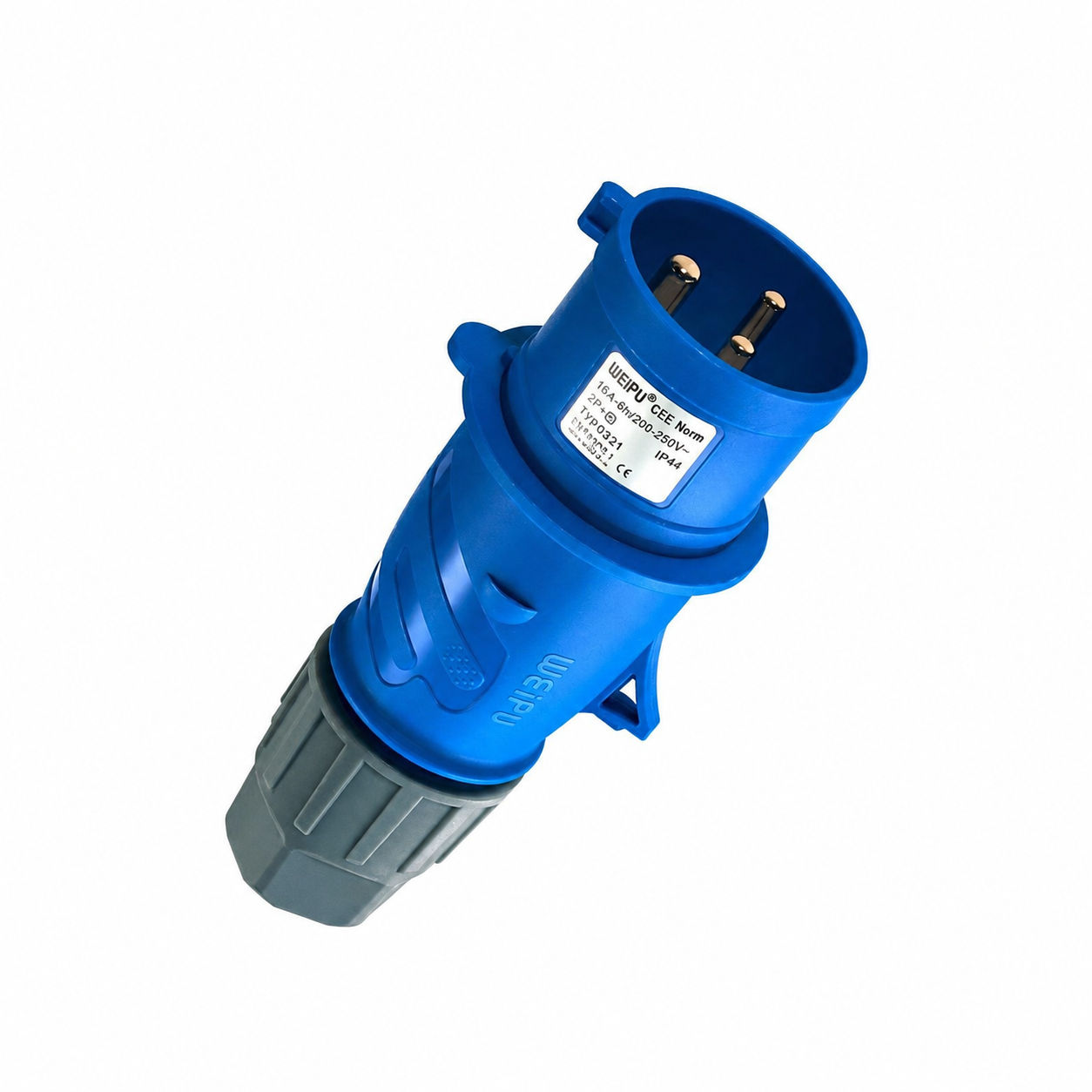
Does 6h always mean 230 V? A 380–415 V, 3P+E configuration at 50/60 Hz can also be 6h. Its four contacts make it a different interface. Likewise, the plug's ampere class has to match the socket size. Read the clock code together with pole arrangement, voltage, frequency and current. Mechanical compatibility cannot establish how an existing circuit was actually wired. WEIPU plug specification
| Marking or feature | What it identifies | What it does not establish |
|---|---|---|
| 2P+E / 3P+E | Pole arrangement including protective earth | Current rating or actual circuit wiring |
| 6h / 4h | Earth-contact angular position relative to the keyway | Voltage by itself across all pole groups |
| 16 A / 32 A | Rated current class and corresponding interface size | Permission to use mismatched halves |
| Voltage and frequency | Intended electrical application | Correct wiring of an existing installation |
| IP44 | Defined ingress protection | Chemical, impact or directed-jet suitability |
What IP44 means at the worksite
The first 4 addresses solid foreign objects 1 mm in diameter and larger. Fine dust requires a separate assessment. The second 4 addresses water splashing against the enclosure from any direction under the specified test conditions. The IP code describes ingress protection. Electrical compatibility, impact resistance and suitability for cleaning chemicals each need their own evidence. MENNEKES IP code tables
| Exposure | Why it is different | Evidence required |
|---|---|---|
| Occasional splashing | Water reaches the assembly without a directed cleaning jet | Applicable rating in the assembled condition |
| Directed washing jet | Pressure, direction and temperature can differ from splashing | Suitability for the stated wash process |
| Connection lying in water | Exposure can become immersion | Applicable depth, duration and complete assembly rating |
| Unplugged during maintenance | Mating seal no longer closes the interface | Approved protection for the exposed halves and caps |
- Covered service bay, occasional splashes. A plug-and-socket pair raised off the floor may be suitable if its documented protection applies in the fitted condition. Check the mating surfaces, cable entry and jacket for wear that would compromise that protection.
- Hose-cleaned production area. A jet directed at the joint applies a different water test. Specify the wash pressure, temperature and direction, then obtain a pair rated for that cleaning method. Choosing a connector on its immersion rating alone also leaves the jet question open.
- Lead in a floor depression. Once water collects around the coupled connection, the exposure can become immersion. Re-route or elevate it where practicable. If immersion is part of normal service, specify the depth and duration and verify the complete assembly for that condition.
Which state carries the rating?
During production the plug may be mated. During cleaning the tool may be removed, leaving the socket covered and the loose plug exposed. These are three distinct configurations. The public TYPR231 record gives IP44 but does not identify the tested configuration. Obtain the manufacturer's declaration for the actual mating pair and cover before relying on a rating in any of those states. For the buyer, the most useful evidence is a mating-face photo, both part markings and a description of exactly where the water comes from. Field replacement checklist
Need help selecting? Send photos of the model, nameplate and installation; quantity may be unknown.
Related reading
How to Choose a Replacement IEC 60309 Plug: 16A, 230V, 6h
Match the socket markings, conductor size and cable outer diameter before ordering. Use this specification table and procurement checklist to avoid a plug that fits the socket but not the cable.
Read article →