
Robot Power Leads: Resistance, Local Heating and Motion Duty
Separate voltage drop along the cable from heating at a connection, and understand why conductor size alone cannot qualify a different drive-cable length.
Need help selecting? Send photos of the model, nameplate and installation; quantity may be unknown.
A power lead has electrical and mechanical limits. Its conductors carry current, its contacts form local interfaces, and its insulation, shielding and routing form part of the equipment system. Matching connector shape and nominal cross-section does not settle every requirement.
Resistance connects length, voltage drop and heating
For the same conductor material, cross-section and temperature, resistance increases with length. In a simple resistive path, voltage drop = I × R and heat generation = I² × R. Doubling current therefore doubles voltage drop and quadruples resistive heating if resistance is unchanged.
As an illustrative DC circuit calculation, assume a total outgoing-and-return resistance of 0.20 Ω. At 5 A, drop is 1 V and resistive loss is 5 W. At 10 A, they are 2 V and 20 W. These assumed values explain scaling; they are not ratings for either robot cable listed below and are not a complete motor-drive cable model.
| Assumed case | Voltage drop | Resistive loss |
|---|---|---|
| 5 A through 0.20 Ω total path | 1 V | 5 W |
| 10 A through the same path | 2 V | 20 W |
| 10 A through twice that resistance | 4 V | 40 W |
Location matters when interpreting heat
Distributed cable heating and concentrated contact heating can have different causes. A poor connection can dissipate power in a small volume while the surrounding cable remains relatively cool. A crowded or poorly ventilated route can instead affect heat removal over a longer length.
Record where discoloration or abnormal temperature occurs, the load state and surrounding conditions. Qualified personnel should follow the equipment's procedures for inspection and electrical measurement. Avoid treating a surface temperature impression as a conductor or contact rating.
A drive cable is more than a DC resistor
Drive-system requirements can include approved length, construction, shielding and bonding arrangements. Changing length can affect more than voltage drop. A larger conductor does not by itself qualify the resulting cable for the controller, motor or feedback arrangement.
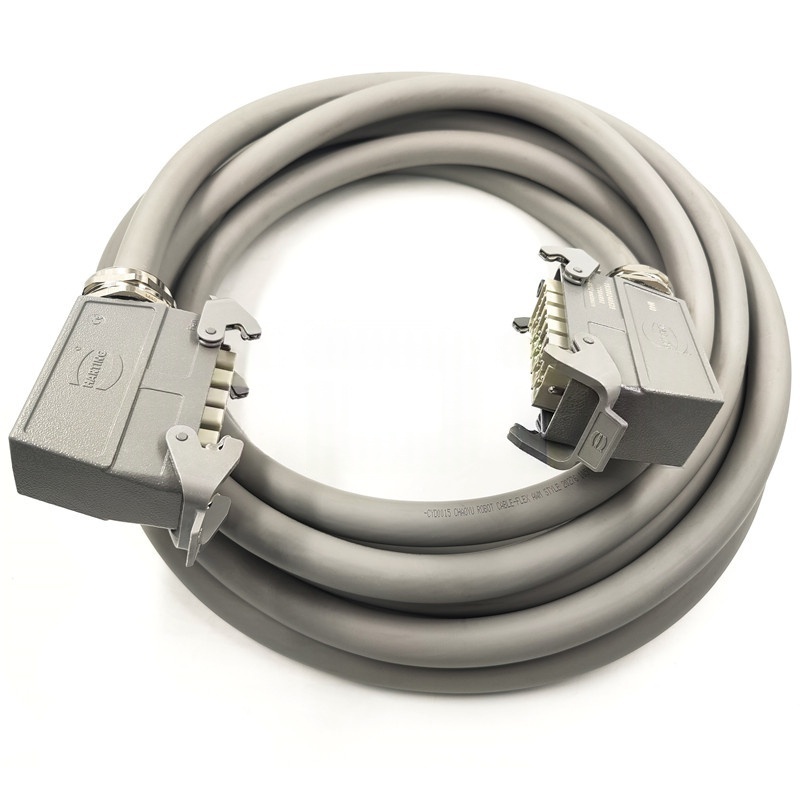
The Ruifeng ABB 3HAC2492-1 and Yaskawa HW0270816-10 cross-references identify separate proposed assemblies. Use the appropriate equipment documentation for each; an ABB controller manual cannot qualify a Yaskawa cable.
| Change or symptom | Technical question | Record needed |
|---|---|---|
| Longer route | Is the new length permitted by the equipment? | Exact controller and cable specification |
| Hot connector region | Is resistance concentrated at the interface? | Contact inspection and approved measurements |
| Warm bundled run | Are load and heat removal within requirements? | Current, ambient condition and installed grouping |
| Cable moved into an articulated arm | Is the construction suitable for flexing and torsion? | Dynamic cable limits and route |
| Fault after rerouting | Did bonding, separation or restraint change? | Before/after installation details |
Preserve the accepted order code, routing, restraint and test requirements together. A cable approved for a stationary cabinet-to-base connection should not be promoted to a moving-arm application solely because it is flexible by hand.
Product and technical references
- ABB Manipulator Control Power Cable, Cross-reference 3HAC2492-1
- Yaskawa DX 2BC Power Cable, Cross-reference HW0270816-10
ABB IRC5 product manual Catalog source for the example
Read the field selection guide
Need help selecting? Send photos of the model, nameplate and installation; quantity may be unknown.
Related reading
Choosing a Robot Controller-to-Base Power Cable Assembly
Identify both endpoints, measure the routed length and confirm the approved cable configuration. Includes ABB and Yaskawa cross-reference examples and a quotation checklist.
Read article →