
How to Size an Electric Gripper: Stroke, Finger Reach, Force and Control
Compare adaptive and parallel electric grippers against the actual part family. Includes a selection matrix and the information needed to quote the mechanical and control interfaces together.
Need help selecting? Send photos of the model, nameplate and installation; quantity may be unknown.
An electric gripper needs sufficient opening, suitable finger motion and adequate force at the actual contact point. Its controller interface and feedback also have to fit the machine. Selecting the largest force number can still leave a gripper unable to enter the fixture or release the part correctly.
Define the complete part family
List the narrowest and widest grip dimensions, the heaviest part, fragile features and the intended contact surfaces. Include insertion clearance and dimensional tolerances. Ask whether the stated stroke is total jaw separation or travel per jaw, and compare it with the manufacturer's drawing rather than inferring it from the model number.
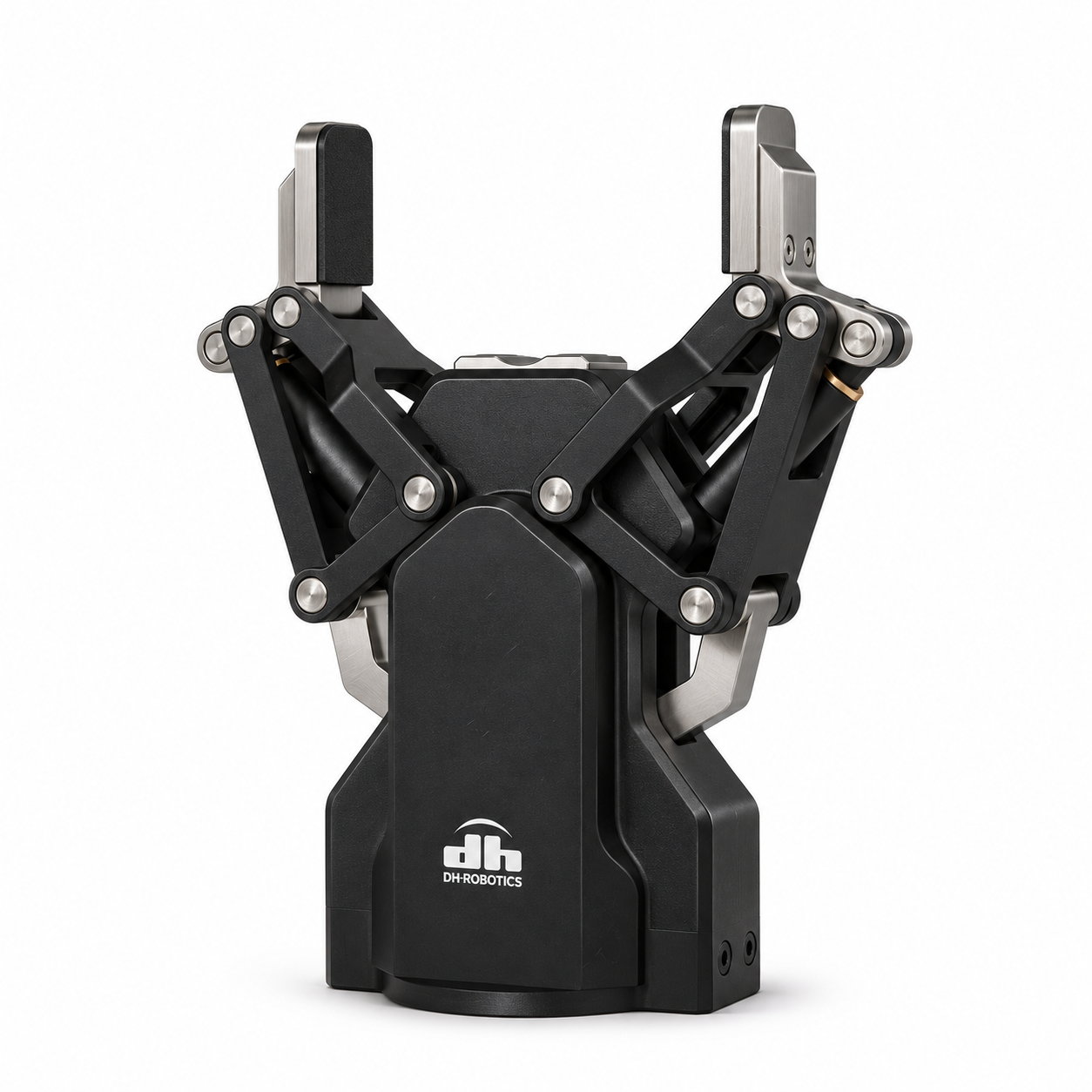
DH-Robotics describes the AG series as linkage-type adaptive grippers. The catalogue's AG-160-95 and parallel PGC-50-35 provide two different mechanisms to evaluate. Their finger trajectories and interaction with a curved part can differ; a common electrical supply does not make them mechanical substitutes.
| Requirement | What to compare | What the buyer should send |
|---|---|---|
| Opening and reach | Usable gap and finger path through the approach | Part extremes and fixture clearance |
| Contact | Finger profile and location on the part | Contact-face drawing and surface condition |
| Force and loading | Defined force at the proposed finger extension | Finger length, mass, offset and acceleration |
| Release | Open-state clearance and part separation | Placement nest and withdrawal route |
| Control | Supply, communications and feedback | Robot/controller interface requirements |
Ask for force at your fingers
State the contact height and finger extension. Ask whether force is specified per finger or for the complete grip and what operating condition applies. Longer custom fingers change the loading on the mechanism; their acceptance should come from the manufacturer's applicable limits and review.
A mixed-part trial should include the part most likely to slip and the part most likely to deform. Do not use the maximum force setting as the default for everything. Agree the acceptable part condition, capture behaviour and cycle outcome with the process owner.
Make feedback useful to the machine
Define the states that the robot program needs to distinguish: ready, moving, holding a part, empty close and fault, where supported. Ask which of these are available on the exact controller/protocol variant and how they are interpreted. A reported jaw position alone does not prove that a workpiece is securely captured.
Confirm supply, communication hardware, software requirements and cable scope before issuing the order. Also ask how the exact gripper behaves during power or communication loss. Do not assume that an “electric” or “collaborative” product label resolves machine-level retention or personnel-safety requirements.
| Include in the enquiry | Require on the proposal |
|---|---|
| Part set and contact drawings | Recommended mechanism and gripping range |
| Custom finger drawing and load case | Applicable force/load limits and exclusions |
| Robot flange and tool envelope | Adapter and mounting arrangement |
| Controller and operating sequence | Protocol variant, cables and available signals |
| Acceptance criteria and quantity | Trial scope, accessory list and lead time |
Evaluate pickup and release using representative parts, not just an unloaded open/close demonstration. Record the approved finger revision and control settings with the supplied order code. These details make a repeat order reproducible and expose later changes that need a fresh review.
Use Discuss your requirements to send the part range, finger drawing and controller details.
Product and technical references
DH-Robotics AG series data Catalog source for the example
Need help selecting? Send photos of the model, nameplate and installation; quantity may be unknown.
Related reading
Electric Gripper Force Is Not Payload: Friction, Finger Moments and Feedback
Use a transparent friction example to understand holding margin, then separate mechanical limits from commanded force and reported jaw position.
Read article →