
Selecting a Robot Tool Changer: Master, Tool Plates, Utilities and Loads
Specify the complete tool-changing system, not just its payload. Includes a component count, load checklist and quotation schedule for the ANT MAQ50 examples.
Need help selecting? Send photos of the model, nameplate and installation; quantity may be unknown.
A tool changer connects a robot-side master to a compatible plate on each tool. Selection therefore covers every tool, its utilities, the docking arrangement and the control sequence. A catalogue payload alone cannot establish that the complete system suits a long or offset tool.
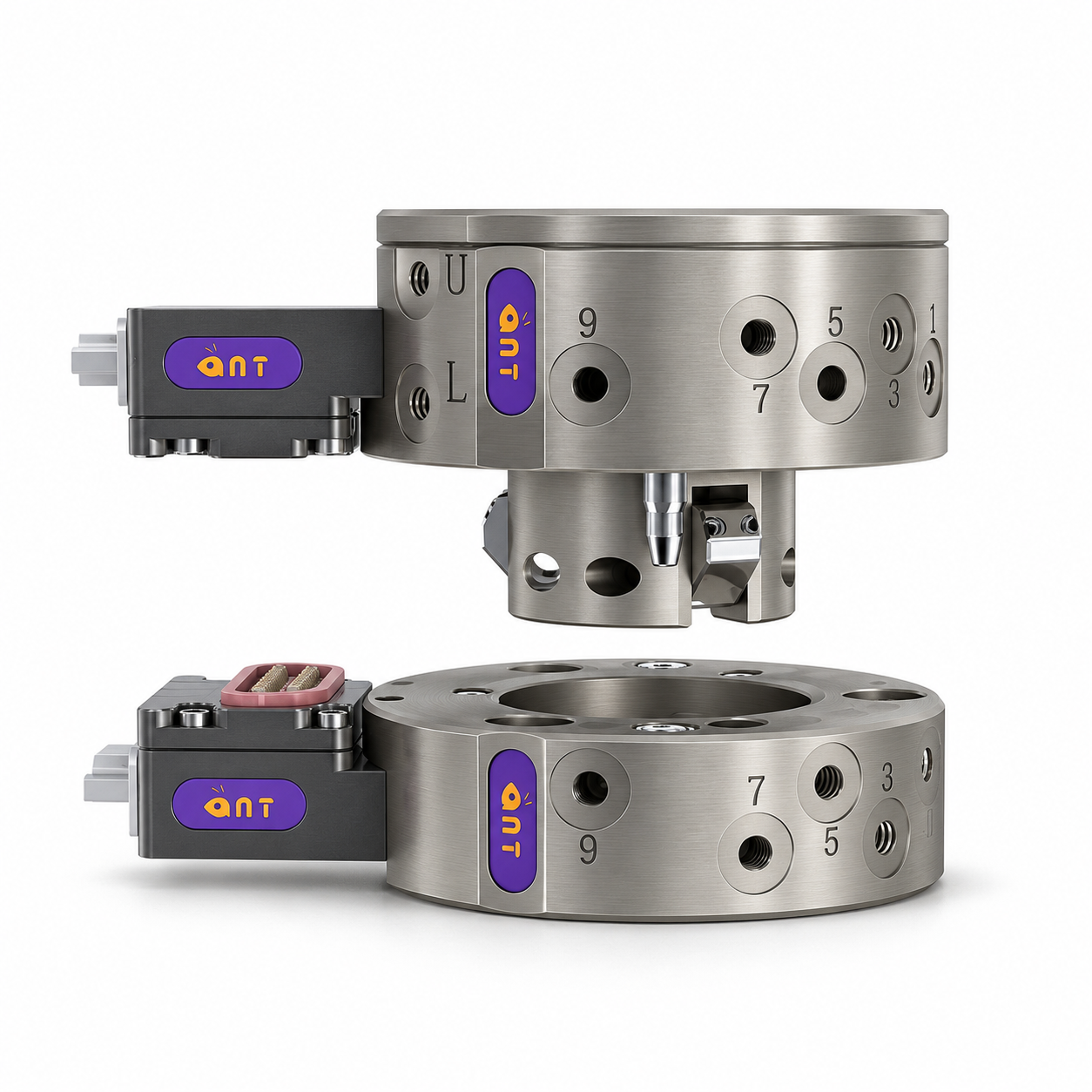
Count the components by function
In a station with one robot and two interchangeable tools, the basic arrangement is one robot-side master and two compatible tool plates. Adapters, utility modules and parking hardware may add separate order lines. This is a scope example, not a claim about the contents of a particular kit.
The catalogue records MAQ50-R-N and MAQ50-T as robot-side and tool-side items. Ask ANT to confirm the pairing, exact revision and included options. A photograph showing both halves does not prove they are both supplied under one order code.
| Component | Information to specify | Count or compatibility issue |
|---|---|---|
| Robot-side master | Wrist flange, adapter and selected variant | Usually assigned to the robot, not to each parked tool |
| Tool-side plates | Matching family and tool interfaces | Each tool needs its own specified connection |
| Utility modules | Air circuits, electrical signals, power or data | Both mating sides and ratings must match |
| Parking arrangement | Tool support, docking access and location | Rack hardware is not implied by a master order code |
| Control accessories | Required sensing and identification | Confirm which options are actually included |
Evaluate the most demanding loaded tool
Prepare a load case for each tool, including the changer plate, adapters, fingers, fittings and the workpiece where carried. State the centre of gravity, acceleration and process forces. Ask for permissible forces and moments in the relevant directions, not simply a maximum mass.
For a long tool, the offset can matter even when its mass appears modest. For a contact process, include the force applied at the working point. The supplier should review the proposed arrangement against the exact changer specification; ratings published for an ATI or another manufacturer's example cannot be transferred to the ANT unit.
Define docking and the handover sequence
Give the integrator the intended approach, available rack space and the tool's supported position. Ask what alignment tolerance is permitted and which signals confirm the relevant stages. Ready-to-lock, locked, tool-present and identification are distinct functions and may depend on fitted options.
The machine design must define release conditions and reactions to missing signals or utility loss. Do not assume an accessory label provides a safety-rated function. Have the responsible integrator validate the complete sequence using the manufacturer's documentation and the machine assessment.
| Send for quotation | Ask the response to include |
|---|---|
| Robot flange and tool-interface drawings | Master, plate and adapter codes |
| Mass, offset and process loads for each tool | Suitability statement with relevant limits |
| Utility circuit list | Complete mating modules and ratings |
| Rack layout and control requirements | Docking limits, required options and scope exclusions |
| Tool count, spare strategy and delivery date | Itemised quantities and lead time |
Before ordering several plates, agree the first-tool review and acceptance record. Check the fitted configuration, utility continuity and controlled docking sequence. Retain the approved drawings and module list so a later tool addition is evaluated against the same interfaces.
Use Discuss your requirements to send the tool list and wrist drawing rather than requesting an unspecified “50 kg changer.”
Product and technical references
ATI example of load and moment ratings Catalog source for the example
Need help selecting? Send photos of the model, nameplate and installation; quantity may be unknown.
Related reading
Robot Tool Changers: Load Moments, Docking Error and Lock Confirmation
Understand why tool mass is insufficient for sizing, how docking tolerance differs from repeatability, and what each coupling signal actually proves.
Read article →